Mission: Impossible 2 was terrible.
After the first film revived a long-dead 1960s TV show with a solid spy thriller featuring some of the best action sequences of the decade, the follow-up was a mess. Directed by John Woo, the film turned into a showcase for the legendary Hong Kong filmmaker’s directorial flourishes, most notably his overuse of slow motion and his laughably over the top action sequences (like the famous motorcycle duel). In other words, Woo wasn’t particularly interested in setting up Tom Cruise‘s Ethan Hunt as the face of a franchise that could keep going for another two decades. Thankfully, Mission: Impossible III came along and paved the way with clean directing that showcased the action, a solid spy plotline, and a villain who still stands as the best in the franchise.

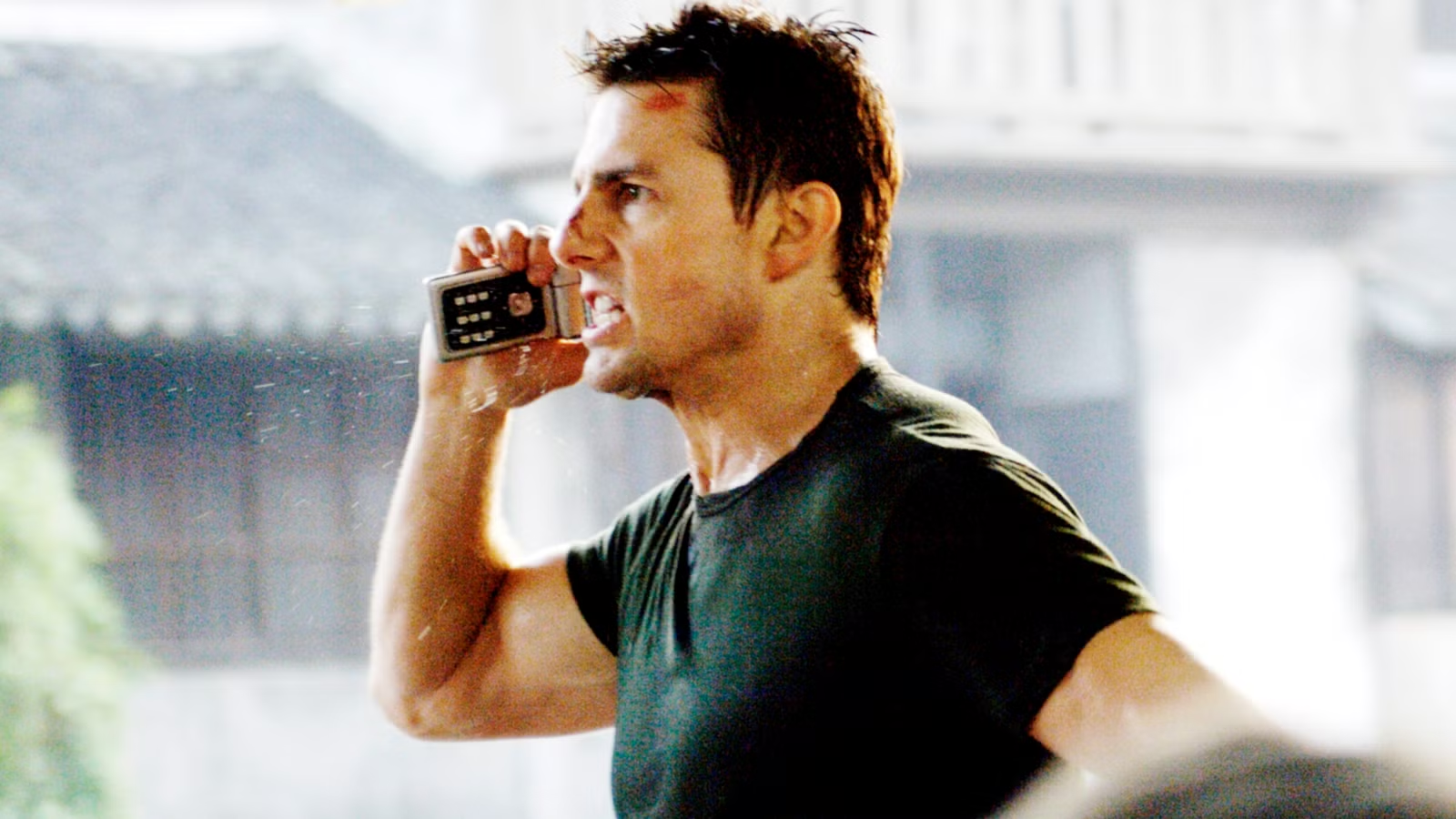
Directed by J. J. Abrams and released 20 years ago on May 5, 2006, Mission: Impossible III features a retired Agent Hunt reentering the Impossible Mission Force (IMF) to save an ex-student of his who had been investigating an arms dealer named Owen Davian (Philip Seymour Hoffman) who’s chasing after a mysterious biological weapon known as the Rabbit’s Foot.
What works so well about Mission: Impossible III is that it reaffirmed the international spy thriller success of the first film while also finding ways to amplify its pacing with more twists and turns. The first movie has some pretty spectacular set pieces, like the opening where Hunt’s original crew dies, the scene where the aquarium restaurant explodes and, of course, the sequence with Cruise hanging from the wire. In between those scenes, however, Mission: Impossible slows down quite a bit. Abrams, in contrast, fills the space in between those big action set pieces with more kidnappings and surprise reveals.
Despite adding more twists and turns, Abrams keeps the plot clear thanks to a lot of necessary but never clumsy exposition. Every Mission: Impossible film after this one is similarly paced, which keeps them moving along nicely, even if they sometimes had a little too much of characters explaining things.
Mission: Impossible III also introduced Simon Pegg as Benji Dunn, who adds a necessary dose of humor. While Cruise’s onscreen, brotherly chemistry with Ving Rhames’ Luther Stickell was key to the franchise’s heart, Pegg injected some much-needed levity.

The action sequences in Mission: Impossible III are also solid, if not spectacular. The big moments come when Hunt sneaks into the Vatican to stop Davian from stealing the Rabbit’s Foot, when Davian’s forces blow up the Chesapeake Bay bridge to rescue him, and when, in Shanghai, Hunt jumps from one high-rise building to another.
Strangely, despite the fact that Mission: Impossible films are known for their action and that this is one of the best films in the franchise, it doesn’t really have any truly momentous action sequences. Instead, Mission: Impossible III’s most memorable scene is more about character than spectacle. Teased at the beginning of the film and then shown in full towards the end, the scene features Hunt waking up handcuffed to a chair. His wife is bound and gagged facing him with Davian holding a gun to her head. Davian demands to know what happened to the Rabbit’s Foot and threatens to pull the trigger at the count of 10.
The scene is a showcase for both Cruise and Hoffman as actors. In the scene, Hunt thinks he gave the real Rabbit’s foot to Davian, so he’s completely confused as to what Davian is talking about. As Davian counts slowly, Hunt tries a different tactic in between each interval, from threatening Davian to begging him to stop to outright lying and saying he knows where the Rabbit’s Foot is (which he doesn’t).
Meanwhile, Hoffman is relentlessly menacing. He is mostly dead-eyed throughout, though he lets out a few bits of explosive anger. When he reaches 10, he pulls the trigger. It’s later revealed via Mission: Impossible mask stuff that this wasn’t really Hunt’s wife, instead it was a female employee of Davian who had let him down, but even knowing that on second viewings, Hoffman is still terrifying and . Cruise does some of the best acting of his whole career.

While Davian has a handful of other good scenes, he really doesn’t occupy a great deal of screentime, yet Hoffman still managed to create the best villain of the entire Mission: Impossible series. While the Mission: Impossible films are often compared to James Bond, they never quite delivered memorable villains like Bond films did. Davian, however, is the exception.
Going forward, with the first film and third films as templates — and the second film as a lesson in what not to do — the Mission: Impossible franchise went on to make billions. While the films are sometimes formulaic, every future installment would be fast-paced and clearly directed showcases for spectacular action sequences. They’re the kinds of movies that demand the big screen and prove audiences can tell when stunts are done with grounded, practical effects as opposed to CGI. And with the series possibly being over with 2025’s Mission: Impossible – The Final Reckoning, we can only hope other franchises and filmmakers continue to keep that candle lit.
About the Author