I’m a complete sucker for the solitaire games of Grey Alien Games — a.k.a. Jake Birkett, a solo developer from the pleasant English county of Dorset, assisted by his partner Helen Carmichael, who writes the stories. (I met Helen at a recent game show; their son, a recent games programming graduate, was with her, joining the family business.)
Grey Alien’s solitaire games involve clearing cards arranged in decorous, fanned layouts. They’re super relaxing, with immaculate gamefeel, and fun arcade mechanics like combo counters, power-up cards, and so on. Some of these mechanics change from game to game, but others stay the same. Birkett knows his formula isn’t broke and he never tries too hard to fix it. That’s fine with me.
Grey Alien’s most well-known titles are probably the Regency Solitaire games, which offer the most casual variation on this inherently casual gameplay style, arranged alongside Carmichael’s gently hilarious spoof of a Jane Austen plot. Other games in Birkett’s solitaire oeuvre include the more involved puzzle RPGs Shadowhand and Ancient Enemy, which feature things like combat (via the medium of solitaire) and leveling.
The latest game in this unofficial series has made a stylistic lurch into horror. Forbidden Solitaire is a collaboration between Grey Alien and Night Signal Entertainment, a Utah outfit that specializes in fourth-wall-breaking FMV analog horror channeling the creepiness of the early internet. Night Signal made a minor splash with 2024’s Home Safety Hotline.

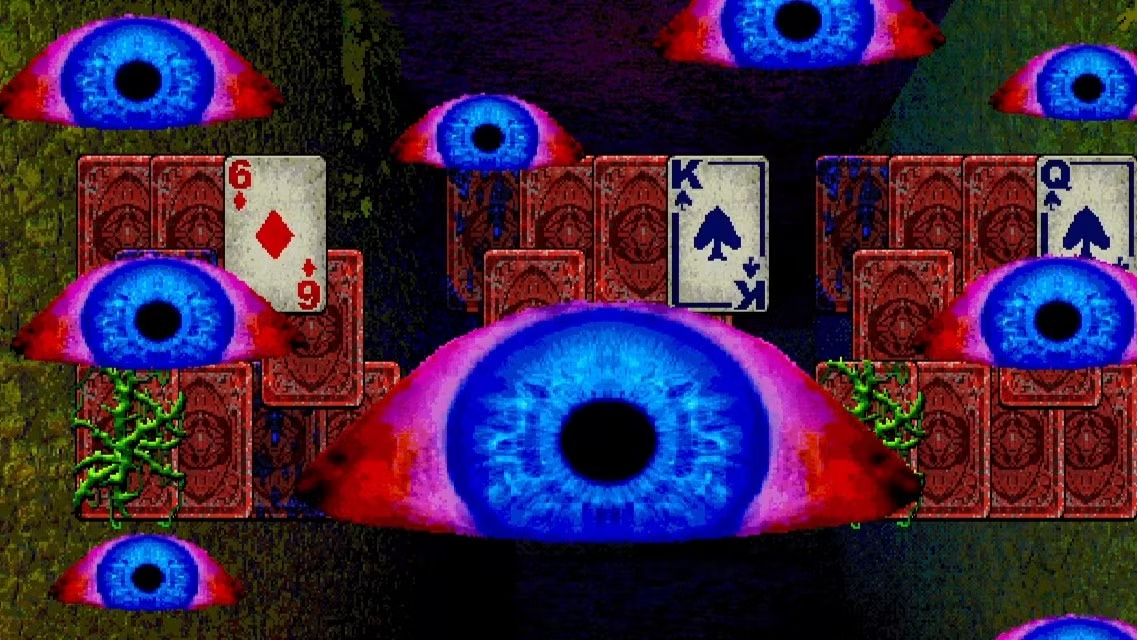
The premise of Forbidden Solitaire is that you’ve found a cursed CD-ROM with a copy of a banned horror solitaire game from the 1990s on it. Grey Alien and Night Signal’s commitment to the bit includes a postmodern framing device. The first thing you see on starting the game is an approximation of a modern-ish Windows lock screen, and you boot the CD-ROM from the desktop with a nostalgic whir. Your gameplay is interrupted by IMs from your sister, who’s digging into the game’s dark past and sends links to reports of grisly “real-world” murders and period FMVs about the Satanic panic that surrounded the game.
Night Signal’s mastery of this kind of thing is perfectly expressed in the game itself, with its sickly green-and-purple colour scheme and crude, rubbery, pre-rendered 3D graphics. The story is about a wizard exploring a dungeon crawling with maggots and gross monsters, but the nastiest touch might be the way upgrades bought from the shop come in the form of gems that are bloodily embedded in the wizard’s hand. The more you play, the more the game’s fiction starts to bleed into the unsettling story of its making.

I found all this more funny than scary, but either way it’s a mood, and as an evocation of a certain grimy ’90s PC gaming aesthetic, it’s devastatingly accurate. (The perfectly doomy synth music made me think of The X-Files and Diablo.)
For me, it’s just another diverting frame for the best computer solitaire you can buy. Forbidden Solitaire eschews the leveling of Shadowhand and Ancient Enemy but finds other ways to gently deepen the classic Grey Alien design and inject it with a little extra tension and bite, as befits the theme.
It’s a long way from Regency Solitaire. Or is it? Birkett is a veteran of the era Forbidden Solitaire represents, and there’s less distance than you might think between the casual game portals he used to work on and the CD-ROM trash his new game pretends to be. (He fought to get the game small enough to actually fit on a CD-ROM, but at 960 MB, it’s just a little too big.) Both in Night Signal’s concept and visuals, and Grey Alien’s design and coding, Forbidden Solitaire displays a deep knowledge and love of its subject — like all the best spoofs. And clicking on the cards feels great.
About the Author