In practical terms, we are years if not decades away from the end of the Marvel Cinematic Universe. But if it truly hopes to emulate its comic-book source material in longevity, Marvel will have to accept a formulation of eras — silver, golden, platinum, infinity, whatever you want to call them — delineating various groupings of superhero movies in terms of quality and style, not just their phased narrative arcs. Most people would probably agree that at some point in the past decade, the golden age of the MCU ended. What they might not realize is that the seeds of its destruction were planted by no less a beloved figure than Captain America (perhaps the single character most thoroughly redeemed in his journey from the comics to the MCU) in a movie that was a critically admired, fan-approved box office hit.
In other words, not Captain America: Brave New World. That’s probably the worst MCU movie so far – and as a result, almost nothing it does will matter much in the long run. Brave New World won’t shift the course of MCU filmmaking, because no one will particularly seek to emulate it. Captain America: Civil War, on the other hand, has been able to wreak plenty of destruction, tearing apart the MCU more efficiently (and more quietly) than Baron Zemo could ever hope since its release a decade ago on May 6, 2016.
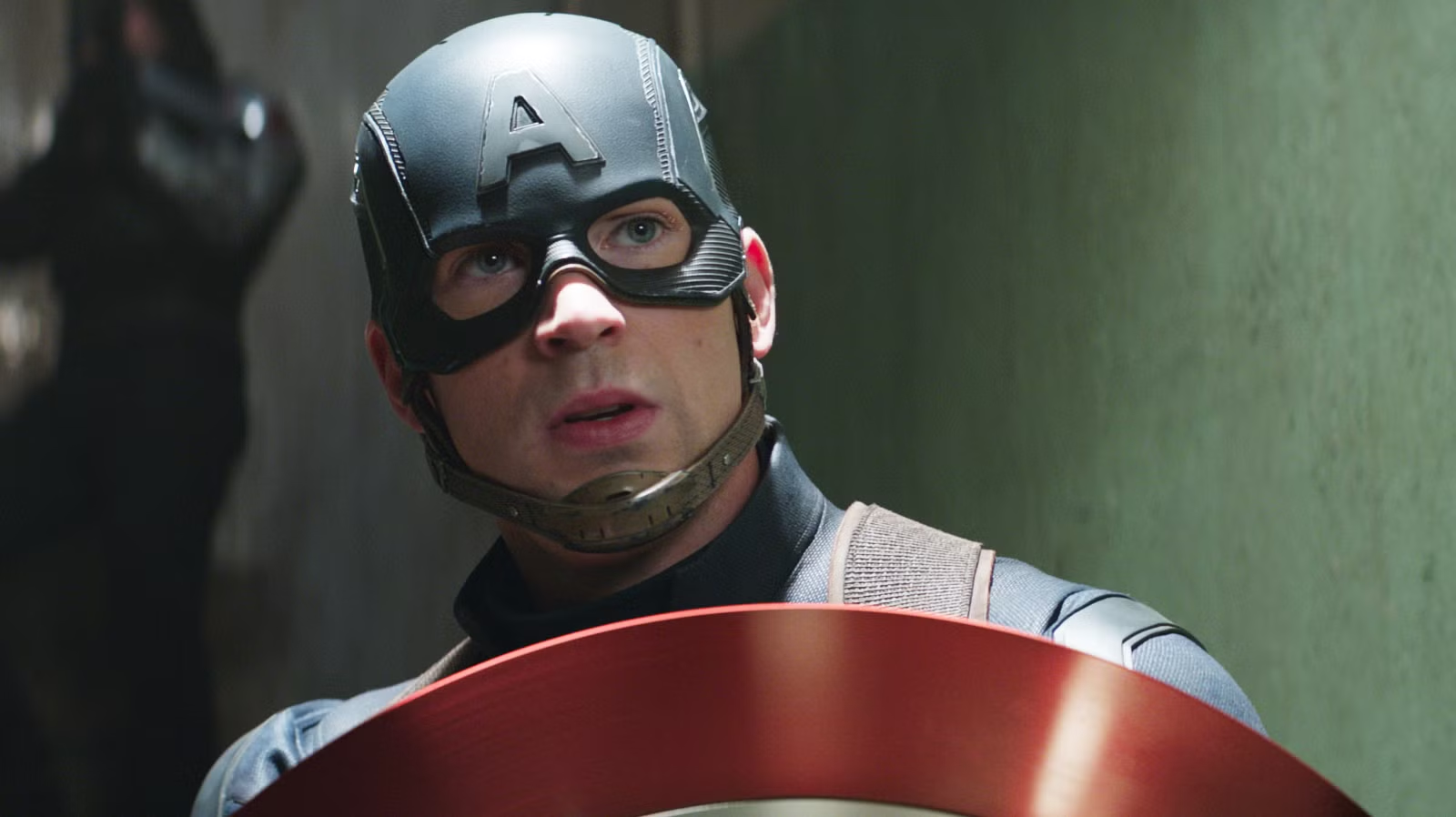
That doesn’t make it a bad movie on its own. Most of Civil War is entertaining, packed as it is with well-established and well-motivated characters like Cap (Chris Evans), Black Widow (Scarlett Johansson), Scarlet Witch (Elizabeth Olsen), and Tony Stark (Robert Downey Jr.). It also manages to introduce the MCU versions of Black Panther (Chadwick Boseman) and Spider-Man (Tom Holland), effectively teasing their respective solo movies. Oh, and there’s a delightful scene where most of the Avengers and Avengers-adjacent personnel (sans Thor and Hulk) divvy up and fight each other for a truly memorable superhero-movie set piece.

But wasn’t this supposed to be a Captain America movie?
It’s not that Steve Rogers doesn’t get enough to do in Captain America: Civil War. Evans remains steadfast and terrific in the role, selling the potentially dodgy idea that Cap would stubbornly resist any government oversight following the latest superhero-abetted instance of collateral damage that the film’s opening Avengers mission causes. But it doesn’t take long for Tony Stark’s point of view to receive near-equal weight; Downey’s star power and popularity make up any deficit in screen time as he gets several sequences all to himself, including a clunky establishment of his past family dynamics (more on that later), and a charming but ultimately perhaps misplaced Spider-Man recruitment scene that stops the movie cold for a Spider-Man: Homecoming preview. Both fittingly and frustratingly, about half of Civil War winds up as a proper Captain America movie. The rest is basically Avengers 3.
In fact, this would have made a very good Avengers 3 (especially considering that Infinity War barely features the Avengers as such), especially if it had been able to forestall the rush towards an infinity-stone mega-climax, leaving more room for a third proper solo Cap movie. Obviously that decision to barrel ahead paid off financially. But narratively, it feels a bit like Captain America’s story trails off during his own movie before re-emerging for some of the more emotional scenes in Endgame.
The rush toward universe-shifting climax is not all (or even mostly) on the shoulders of Civil War. But on its own terms, the movie still falls apart sometime after that big airport scuffle. Initially, the central conflict between Steve and Tony is framed as a battle between two principles, which in turn are shaped by each hero’s respective experiences. Steve is wary of government oversight on his day-saving, because he’s still shaken by the fact that Hydra had infiltrated SHIELD for years. Tony sees no other option but to sign the (ill-defined, much-mentioned, and eventually discarded!) Sokovia Accords, because he’s haunted by his role in preventing (and sometimes causing) global threats almost beyond his understanding. Their conflict comes to a head because Steve doesn’t want to take guidance from the government over how to best bring in his pal Bucky Barnes (Sebastian Stan), who has been framed for a bombing that killed the father of T’Challa (Boseman), now Black Panther.

Obviously there are personal stakes, but the philosophical and practical questions about how superheroes should operate in these situations are genuinely interesting on their own… until the movie’s quasi-operatic climax, where Steve and Tony, having put aside their differences to investigate the framing of Bucky, are placed at odds again by the revelation that a brainwashed Bucky killed Tony’s parents. Questions of superheroic autonomy, government oversight, and conflicting loyalties are thrown out so Iron Man can use “he killed my mom” (that’s a direct quote) as a soapy conversation-ender and fight-starter.
This is human nature. It is also, in this particular movie, deeply stupid — an admission that as much as the MCU might gesture toward broader questions, the interconnected soap opera stuff will always come first and matter more, even when dealing with relationships that were effectively just introduced a couple of hours ago. (Was Tony’s mom a major figure in his mythos before that weird de-aged virtual-reality scene?) The MCU will not be an alternate history that reflects our own; it will be an alternate history that’s mainly about itself and its own closed-loop connections.
The means of vengeance for the movie’s string-pulling villain Baron Zemo (Daniel Brühl) further clinches it. Seeking revenge for his family’s death in Sokovia, he finds ultimate satisfaction in… making two friends mad at each other and, as such, breaking up the Avengers. This has to be one of the most life-respecting acts of supervillain vengeance ever conceived; it’s as if Zemo sought to devastate unseen audience members who care about the Tony/Steve relationship, rather than fulfilling his own bloodlust. Again, Marvel lore takes precedence over any kind of emotional realities or sense of real-world gravity. It’s pure Saturday morning cartoon logic.

If that’s the deal with your superhero movie, own it. This material often walks a fine line between earnestly silly and patently ridiculous; Civil War crosses it, all while affecting a self-serious color palette roughly equivalent to the average highway overpass. Directors Anthony and Joe Russo established this gritty, grounded look in their previous Cap movie, the triumphant Captain America: The Winter Soldier. There, the pervasive grayness (including action sequences set on an actual highway overpass) had both simple thematic resonance (placing Cap in the moral murk of a conspiracy plot) and aesthetic distinction, setting it apart from the warmer-looking Iron Man movies. The Russos simply running it back for Civil War augured a lack of visual imagination that would become a sad trademark of their superhero movies going forward — even seemingly part of the Marvel house style, given that this billion-grossing Captain America sequel made nearly as much worldwide as the recent Iron Man and Avengers sequels.
The effects of this Civil War were not felt immediately. In fact, the very next year, the MCU launched into one of its most sustained periods of quality and variety, with Guardians of the Galaxy Vol. 2, Spider-Man: Homecoming, Thor: Ragnarok, and Black Panther sustaining a heretofore unequaled four-movie streak that feels in retrospect like a next-gen version of the run leading into The Avengers. This writer’s hot take that Infinity War knocked out the MCU’s second wind will have to wait for that movie’s 10th anniversary — but Infinity War owes the confidence in its muted-color, endless runway of inside-Marvel recursiveness to Civil War. The golden era was on its way out.
As with comics, these eras are not absolute. Good movies have emerged from the MCU’s post-peak period, just as iconic and durable storylines (in fact, most of the storylines these movies draw upon) have been written well outside the Golden, Silver, or Bronze ages of comics. Some of the recent films, good and bad, suggest an MCU at war with itself. Civil War provides ample evidence that things can sometimes get worse when that battle feels definitively won.
Captain America: Civil War is streaming on Disney Plus.
About the Author