With Kathleen Kennedy stepping down from her role as President of Lucasfilm after 13 years, George Lucas’s protege Dave Filoni and Lynwen Brennan are leading Star Wars into the future. Despite the mixed reception of Star Wars over the years, I remained hopeful that Filoni might lead the franchise into new and interesting places, as long as his reliance on nostalgia doesn’t steer him entirely. My optimism still persists, especially after Maul’s phenomenal first season.
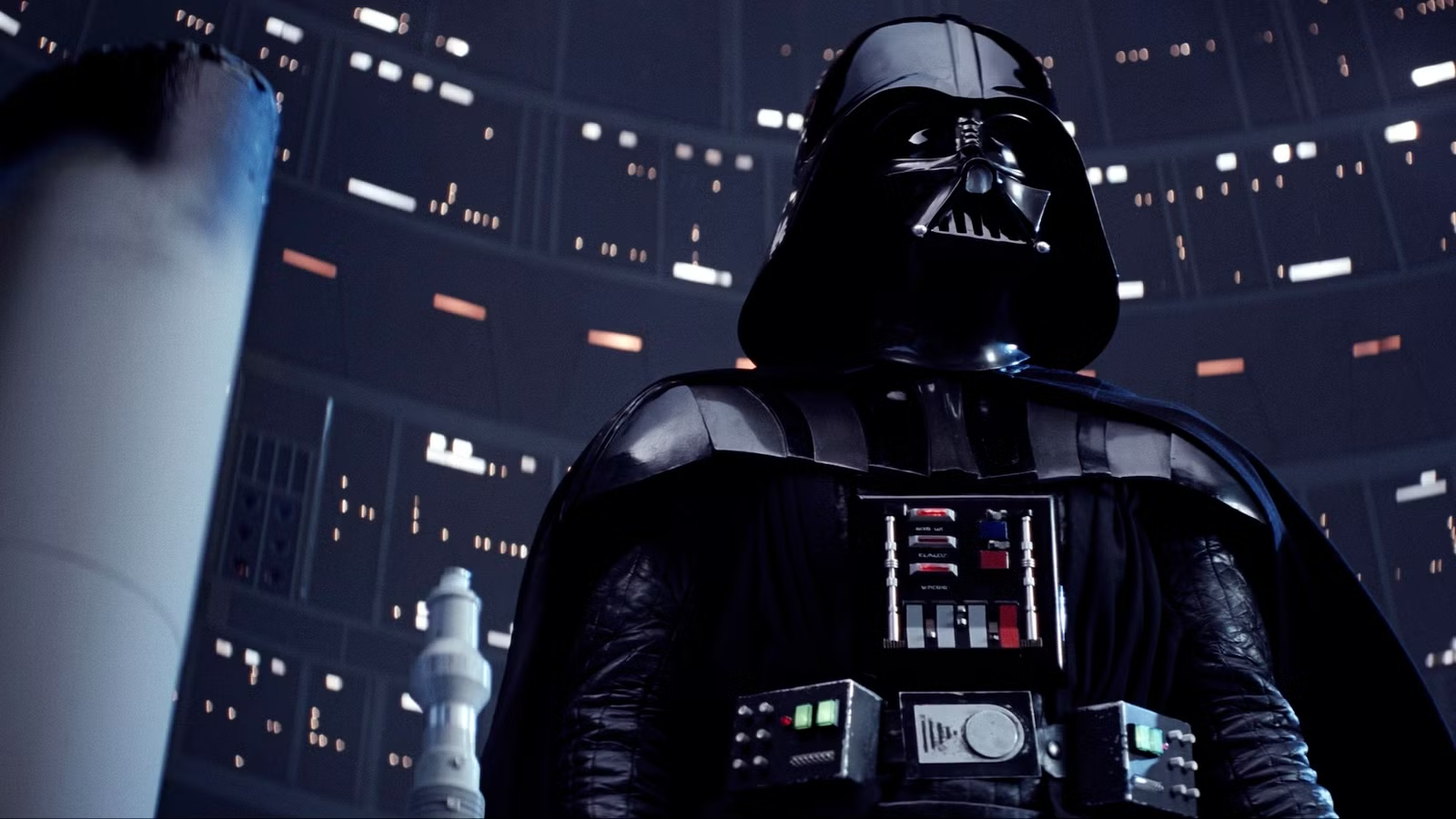
However, and I do hate to say it, but Dave — can I call you Dave? — you’re very wrong about Darth Vader.
At a May 4th event celebrating the two-part finale of Star Wars: Maul – Shadow Lord, Filoni explained his philosophy behind Vader.
“The key to Vader for me is that he’s not Anakin,” Filoni said. “He doesn’t recognize that. He can’t. Anything that reminds him of Anakin, he’s going to destroy. So when he sees a Jedi, he’s going to destroy the Jedi, because the Jedi would remind him unconsciously or consciously that he betrayed all of his friends and everything he knew and the life he grew up with. For what? For nothing. He lost everything. He made a bad trade. He was lied to. He was deceived. He can’t accept that truth.”

Filoni went on to explain that Anakin is trapped in Vader somewhere, but Vader won’t let him surface. “The key is not to actually give [Vader] a character. He’s devoid of it because he doesn’t care. Darth Vader does not care. He does not have compassion. He does not see you. He sees the thing he wants to destroy, and he will do that.”
Now, I can get behind 95% of Filoni’s reasoning behind Vader and why the Sith lord does the horrible things he does. However, I disagree with the claim that Vader is not Anakin, and that the key to Vader is to not give him a character at all.
Since Darth Vader’s debut in 1977, fans, creators, and George Lucas himself have sought to fill in the gaps of the man in the towering black suit and fearsome mask. The iconic reveal of Vader being Luke’s father in the 1980’s film, The Empire Strikes Back is a landmark moment in pop culture. Years later, Lucas explored Vader’s origins as Jedi Knight Anakin Skywalker in the prequel-era movies, a crucial trilogy depicting Anakin’s tragic descent into the horrifying villain we both love and fear.

Vader’s story hasn’t stopped there, either. It’s been explored in comics, novels, and even video games. Across these different media, one thing has always held significant appeal and, in my opinion, is a vital key to understanding Vader: that he is still Anakin Skywalker.
Countless stories show Vader as a fearsome, hulking monstrosity. He cuts a bloody path through numerous rebels in Rogue One, and he doesn’t hesitate in killing his own Inquisitor in Respawn’s Jedi games. Vader doesn’t say a single word in his latest appearance in Maul – Shadow Lord, which aligns well with Filoni’s viewpoint that he isn’t a character but rather a symbol of hate and destruction.
This is a fundamental misunderstanding of the character, and various Star Wars stories have proved that Anakin and Vader are still one and the same. In the 2025 novel Master of Evil by Adam Christopher, set shortly after Revenge of the Sith, Vader shows moments of true compassion and empathy for the Clone Troopers under his command. Even as the ship he’s on is falling apart, Vader takes the time to fix the prosthetic leg of trooper Appo, and even defends his squadron from overwhelming numbers.
Then there’s Vader’s treatment of Padmé Amidala’s handmaiden/decoy, Sabé. In Marvel’s 2020 Darth Vader comics, the Sith Lord rescues Sabé several times throughout the series, such as using the Force to protect her from falling debris. While Vader’s attachment to Sabé is largely due to her being the spitting image of his dead wife, that only further supports Anakin is a key part of Vader’s psyche.

Perhaps the biggest indicator that Anakin and Vader are intertwined comes directly from Deborah Chow’s Obi-Wan Kenobi streaming series. During an epic duel between Obi-Wan and Vader, Obi-Wan reveals Anakin’s face behind Vader’s mask. For a moment, Anakin soothes Obi-Wan’s guilt, telling his old master that he never failed Anakin. Anakin is dead only because Vader killed him.
On the surface, that may seem to confirm Filoni’s argument that the two characters are separate entities, but it’s more complicated than that. Vader may believe his own lie that Anakin is dead, but the fact that he even attempted to comfort Obi-Wan in the first place shows Anakin’s love for Obi-Wan still lives inside him, regardless.
Star Wars fans have long argued about what happens when a Jedi falls to the Dark Side and takes on a new Sith persona. Are they the same, or do they become something new? It’s an argument that has always felt muddied in semantics to me, and while there are certainly some magical, supernatural things happening in Star Wars, it’s also a franchise steeped in tragedy. Filoni understands this when he says Vader has Anakin “trapped,” but unfortunately seems to fall at the hurdle of believing they’re two separate entities.
The tragedy of Vader is that, while he was manipulated and lied to, his undoing came from falling victim to his own fear and turning against everything that he stood for. Anakin Skywalker made that choice and it led to the birth of Darth Vader. To separate Anakin and Vader is to soften the blame of those choices, and if you do that well, do you even understand the tragedy of Vader at all?
About the Author