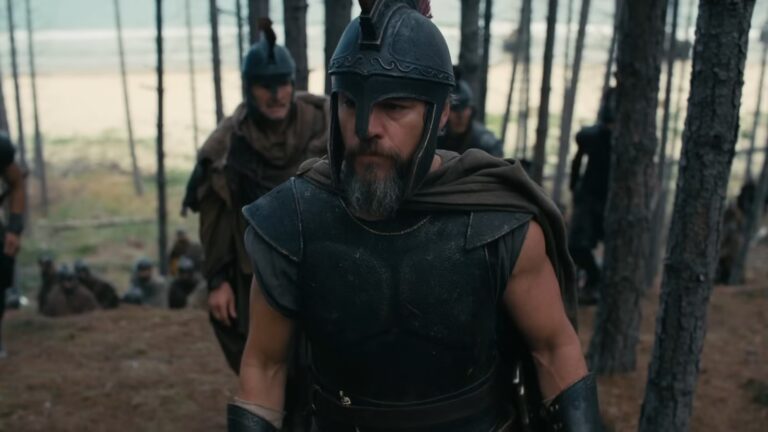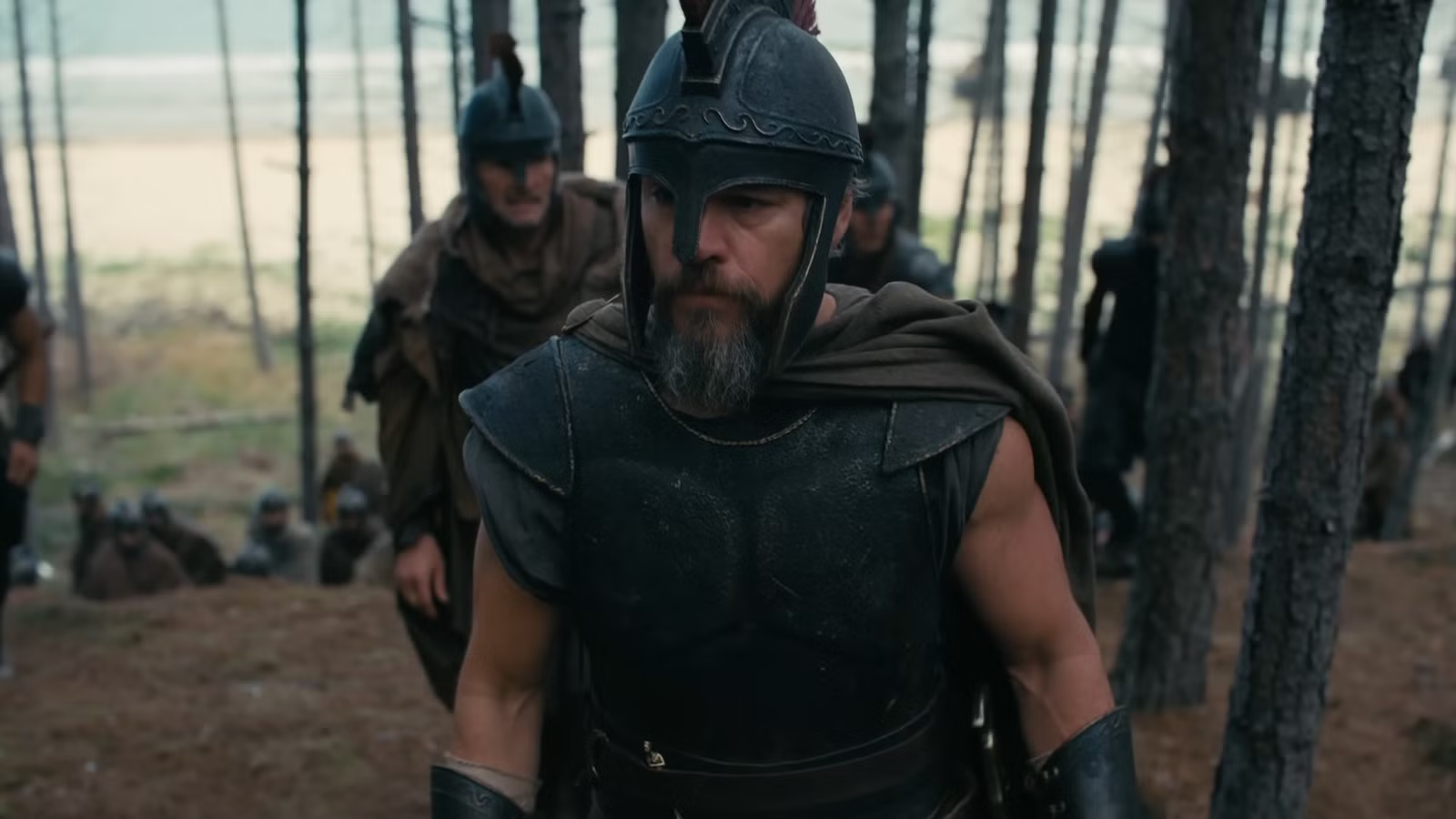
A lot of the online discourse surrounding the newest trailer for The Odyssey, Christopher Nolan’s epic movie that will hit theaters in July, coalesces around Thelemacus (Tom Holland) using the word “dad” to describe his father Odysseus (Matt Damon). But while I appreciate a little linguistic debate as much as anyone else, it was Odysseus’ words, “No one can stand between me and home,” that made my classical studies eyebrow perk up, The Rock-style.
The thing is, Odysseus wasn’t always that eager to go home — or to stay there for long. To be clear, I’m not arguing in favor of or against Nolan’s movie being an accurate rendition of Homer’s poem, but reducing the protagonist to a family man who is desperately determined to return to the comforts of his hearth (as the trailer seems to suggest) misses the parts of the character that make Odysseus one of the most enduring figures in Western literary history.
Around the year 1308 AD, Italian poet Dante Alighieri started penning the Divine Comedy, which would become one of the pillars of modern Western civilization. Dante’s allegorical trip through Hell, Purgatory, and Paradise is a roman à clef, a practical excuse for the poet to depict, under the guise of fiction, figures from real history, often contemporary, making the Inferno feel like a big settling of scores. But Dante also doesn’t shy from flexing his knowledge of the classics. Perhaps the most popular of the ancient characters appearing in his allegory is Ulysses, the Latin name for Odysseus, who is suffering eternal torment in the eighth bolgia of the Eighth Circle, reserved for fraudulent counselors.
While filtered through the condemning lens of Christian values, Dante’s Ulysses is far from a negative figure. In fact, the poets’ representation of the character aligns with a fascination for Odysseus that only grew stronger after his appearance in Canto 26 of the Inferno. The King of Ithaca becomes the personification of humankind’s desire for knowledge and discovery, a trait that inevitably clashes with his duty to return home, creating a powerful dichotomy that is already present in Homer’s poem and adds depth to the character.
In Book 11 of The Odyssey, the protagonist, under Circe’s suggestion, travels to the Underworld to consult the blind prophet Tiresias. The prophecy Odysseus receives tells him that, despite angering Poseidon, the god of the sea, by blinding his son Polyphemus, he will still be able to return home, but his travails won’t be over. To placate the gods, Odysseus will have to set sail again until he finds a land whose inhabitants are unaware of the existence of the sea. There, he will perform ritual sacrifices to Poseidon and finally return to Ithaca to live his final days in peace.

Dante takes this cryptic part of the poem and turns it into the famous “Ulysses’s last voyage.” After killing the suitors and reclaiming his house, Odysseus is restless in Ithaca. Rather than to placate the ire of the gods he offended, Odysseus sets sail with his companions again because he “had to gain experience of the world and of the vices and the worth of men.” When they finally reach the confines of the human world, Dante’s Odysseus exhorts his companions to go further: “Consider well the seed that gave you birth: you were not made to live your lives as brutes, but to be followers of worth and knowledge,” he says. They are then struck down and sunk into the abyss by God, but Dante’s warning about the human limits in the face of the Divine was overshadowed by his own apology for human ingenuity in the previous verses, of which Odysseus became the symbol.
That was already a key trait of the character in The Odyssey. The poem begins with the words àndra polùtropon, “that man of many resources,” marking an anthropocentric shift compared to The Iliad’s focus on the gods and their transcending influence on the world. Sure, Odysseus’ 10-year-long journey home is determined by having angered the gods on several occasions: desecrating temples during the sack of Troy, blinding Poseidon’s son, and killing the cattle of Helios. However, he also happily spent one year in Circe’s company, drinking and feasting until his crew convinced him to leave.
He later spent eight long years with Calypso (played by Charlize Theron in Nolan’s The Odyssey), technically as a captive who spent all his days weeping on the shore, but don’t forget that this is how Odysseus himself tells the story to his audience at the court of King Alcinous, on his last stop before sailing to Ithaca. And the man built his reputation on being a great liar.

From The Odyssey’s trailer, Calypso seems to play a big role in the story, so I’m curious to find out how that dynamic will be portrayed in the movie. Will Damon’s Odysseus really be just a powerless prisoner longing to go home, as the trailer suggests? That would be a gross simplification of the character. Nolan has the opportunity to give us a modern rendition of a character who has become one of the symbols of Western civilization. That can only be achieved by embracing Odysseus’s contradictions, and by not reducing him to a “dad movie” Hollywood stereotype. This probably won’t be easy, considering the movie seems to take a choral approach, spreading its focus among many characters. (You can’t bring in Robert Pattinson and not give him enough screen time, after all.)
Odysseus’ enduring popularity comes from being the most human of the classic heroes. He is easily tempted and often strays away from the path, just like we humans do. Homer’s The Odyssey is, at its core, a story about a man. It would surely be ironic if a movie adaptation produced 27 centuries later turned out to be less realistic than the original.
About the Author