One of Strixhaven’s most famous students is Zimone Wola. The other is Everest Hootersby — a character I made up, who helped me tell a more successful story than the adventures presented in Strixhaven: A Curriculum of Chaos.
Zimone debuted in Magic: The Gathering’s 2021 set called Strixhaven: School of Mages. She was a first-year student in the Quandrix (blue-green) college, studying the intersection of magic, nature, and mathematics. She eventually went on to pursue dangerous graduate-level fieldwork. She also headlines the Quandrix Unlimited preconstructed Commander deck in the brand-new Secrets of Strixhaven set.
A few years back, when I got a rare chance to actually play a character with my Dungeons & Dragons group (I often serve as the Dungeon Master in my homebrew setting), I knew I wanted to finally give the Wizard class a try. Because I happened to have a copy of the Strixhaven: A Curriculum of Chaos sourcebook, I spent days combing through it to make some kind of silly scholar mage. What better way to build a Wizard than to leverage a literal school of magic?
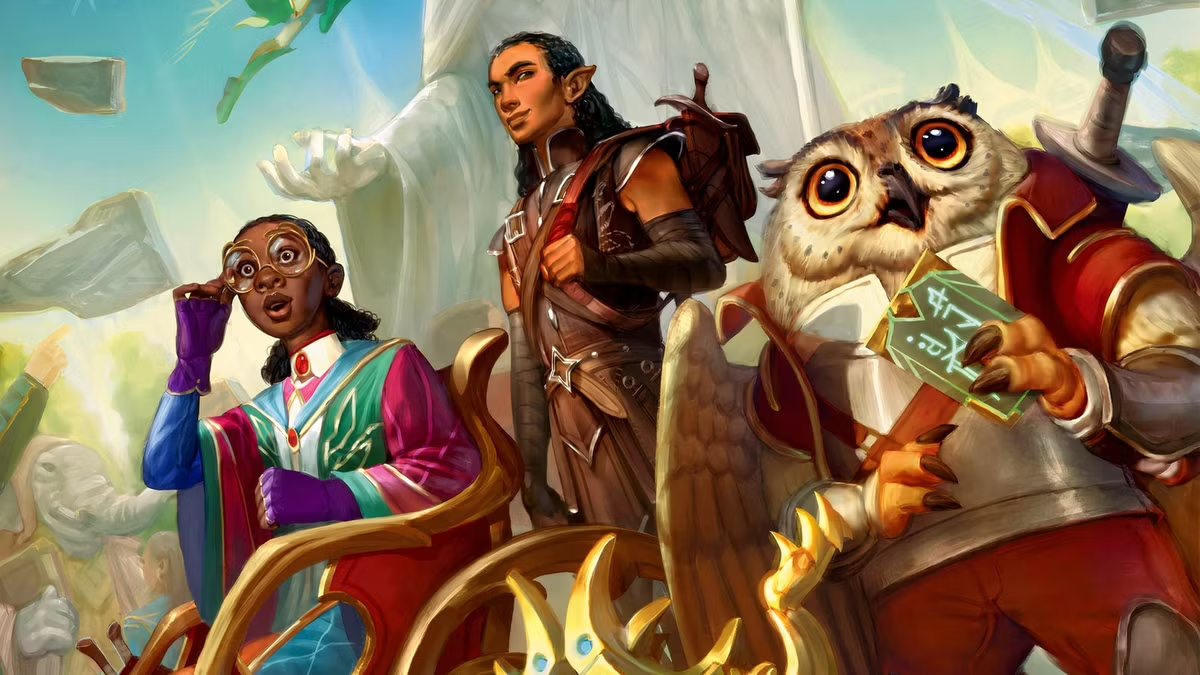
The book has but a single unique race option (which 5.5e now calls ancestry): the Owlin. Like real owls, they move silently, can see in the dark, and have innate flight — three hugely useful features in D&D. Curriculum of Chaos depicts owls of various shapes and sizes. Some are tiny, some are lithe and muscular, but some of them are just comically enormous, like they took a chubby owl, gave them clawed arms, and made them ten times as big.

I adore the way Mavinda Sharpbeak is depicted on the School of Mages card Mavinda, Students’ Advocate. The art reminds me of Raphael’s The School of Athens painting, where Plato and Aristotle huddle close together in conversation — except instead of Plato, it’s this hulking old owl with a topknot and spectacles, gesturing with a scary clawed hand as she stares intently at a Hermione Granger lookalike. Page 40 of A Curriculum of Chaos also has a full page of art depicting three first-years arriving at school. To the right, there’s a chubby owlin with eyes the size of bowling balls. Even the book’s standard cover shows a broad owlin stroking his chin with a mischievous glint in his eyes while the human classmates flirt in the background.
I settled on the name Everest Hootersby for the name of my big, feathery, chubby Wizard and soon discovered a Bottle of Boundless Coffee as a magic item in the book. Thus, Everest’s crippling addiction to caffeine was born. I wanted him to be obsessed with the pursuit of magical knowledge and history, so much so that he tries to sleep as little as possible. That made Lorehold College a perfect fit — especially since the Strixhaven Initiate feat lets Lorehold students pick up a few Cleric spells, giving Everest access to Cure Wounds. Since we were starting this adventure at higher levels anyway, I also picked up the Strixhaven Mascot feat, allowing me to summon Lorehold’s spirit statue mascot.

I’d long been a fan of Tasha’s Cauldron of Everything and was intrigued by the flexibility and breadth of magical knowledge inherent to the Order of the Scribes subclass.
I carefully selected a variety of spells for Everest to capitalize on an intriguing Scribes feature. The Awakened Spellbook allows a Wizard to alter the damage type of any spell in their arsenal. With Erupting Earth in Everest’s spellbook, Fireball instead deals bludgeoning damage as an earthen explosion. Instead of psychic damage, Tasha’s Mind Whip electrocutes the target’s brain. Every time Everest casts a spell, he rewrites it. His party members thought he was insane.
At higher levels, you can manifest your spellbook as a spectral object that can move up to 300 feet away from you, an intangible object that serves as both your spellcasting focus AND the source of all your spells — even those with a range of touch. Functionally, that means as long as Everest can see the target, he can cast his wide array of spells while flying high above the battlefield.
Everest wound up being one of my all-time favorite characters to roleplay. Our adventure was ostensibly a D&D retelling of the book and movie Annihilation, where an alien crashed and corrupted the land in bizarre, almost magical ways — along with our memories. Much like how Zimone wound up doing graduate-level fieldwork in Duskmourn: House of Horror, Everest embraced grave danger to study alien magic and lived to tell the tale. I still hold Everest dear, but the adventure made me realize that Wizards in D&D offer so many options that they can feel overwhelming. What’s more, at higher levels, they’re a little overpowered. But that flexibility is exactly what makes A Curriculum of Chaos such a compelling toolkit. It encourages experimentation, even when that experimentation gets a little out of hand.

The problem with it as an adventure book is that A Curriculum of Chaos doesn’t quite work as a campaign. The tone is all over the place and the character relationships are thinly drawn. It’s also broken up into school years with separate, disconnected adventures, and the narrative throughlines are virtually nonexistent. It often feels like just the outline of a fascinating essay. That means DMs have to do a lot of heavy lifting just to make it work. Were I to run it, I’d probably just pick one year and expand upon a single story.
The promise of a book like this is something that resembles Persona-style D&D, where relationships both in and outside of the classroom enhance the drama and the danger of the adventure. But the book neglects one half of that experience. Strixhaven doesn’t really work as a campaign. But as a setting book — a toolbox of characters, monsters, and magical ideas — it’s one of the most interesting D&D releases of the past decade.

Five years later, A Curriculum of Chaos still isn’t a great campaign. But it might be one of the best D&D books you can own, particularly right now, since we’re on the cusp of Secrets of Strixhaven’s release in Magic.
Making and playing as Everest was a lot of fun for me, and I find myself thinking about him a lot these days. What’s he up to? What would he look like on a Magic card? How might he interact with all of these other characters and monsters presented in Magic’s new set? For any D&D fans out there falling in love with Secrets of Strixhaven, or even the D&D-curious out there, now might finally be the time to buy A Curriculum of Chaos and use it to build your own Everest. Or, if you’re a seasoned DM who’s willing to put in the work, you can definitely use it to tell a lot of interesting stories set at Strixhaven.
As an adventure book, A Curriculum of Chaos is so much less than the sum of its parts, but those parts are honestly really fun to dig into regardless of your level of D&D experience. The real magic is in the worldbuilding, for fans of both Magic and D&D. You just have to give a hoot.
About the Author