Through what magic might a clever sorcerer turn a simple communication device into a weapon that threatens the entire world?
How can restless ghosts and fusion radiation possibly exist in the same world — and what happens when they mingle?
How does an AI cope when it finds itself abandoned on a planet where magic and spellcraft dominate?
And how does a sleeping god react when these events begin to wake her?
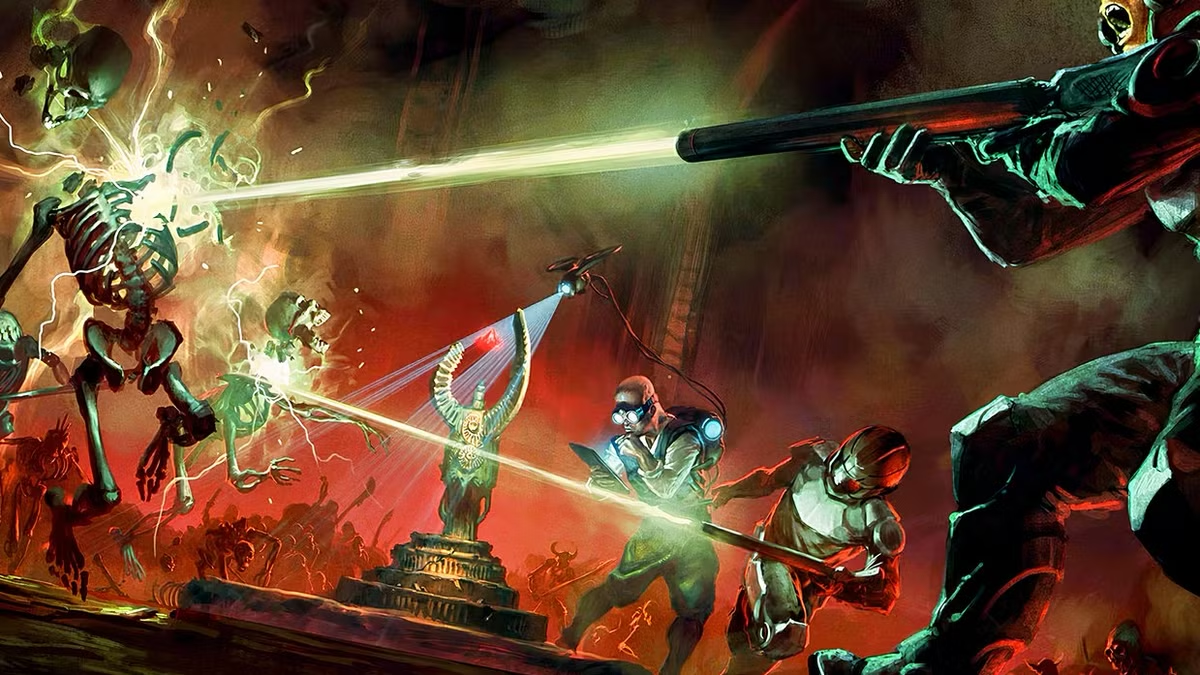
Those are the kinds of questions at the heart of Jewel in the Sky, a new megadungeon from legendary tabletop designer Monte Cook that launched on Backerkit at the start of April — and has since raised more than $176,000. It all takes place in Vocurro, a structure eight miles long that floats a thousand feet above a mountain range. The structure is riddled with a gravity-defying mineral called Inveigh that’s used to power both airships and all sorts of mystical spells.
For all the nuanced ways it fuses together sci-fi and fantasy, the most interesting thing about Jewel in the Sky isn’t its dual setting. It’s what the project says about how megadungeons have evolved over the years.
For decades, the idea of a “megadungeon” has been pretty straightforward: a massive, often punishing meat grinder that’s packed with monsters, treasure, and enough encounters to last months or even years of playtime. In a video interview with Polygon, Cook said he isn’t interested in that linear version of the format anymore.
“This megadungeon stops being a single adventure and really becomes a setting,” Cook said. “It’s got its own sort of rules just like a strange, mystical land or a fantastical forest might. When you develop the idea that this kind of environment is also a setting, then you start thinking about it in terms of things being dynamic with various pieces moving around.”
During a recent Reddit AMA, Cook expanded upon this idea and presented a megadungeon almost like an ecosystem that grows and adapts to the ways that players interact with it. “You might go into some old cave looking for treasure and eventually come upon a whole separate world with different feuding factions, whole new types of magic, and never-before-seen creatures,” he wrote, adding that if players “clear out” a location and then return later, there will be new elements that have changed it. Jewel in the Sky has specific mechanisms that address this exact phenomenon.
Old-school megadungeons were sprawling, combat-heavy gauntlets that you cleared out by defeating the Big Bad and taking all the loot with you as you left. But nobody can “beat” Jewel in the Sky in that sense. “It’s not about clearing the dungeon, it’s about exploring and letting the story threads the designer has woven in there emerge,” Cook said. When — and if — the end comes, it’ll occur because it fits the narrative. Jewel in the Sky is meant to be explored, interpreted, and, in some cases, totally misunderstood.

Cook is currently playtesting the megadungeon with two different groups: one running a traditional fantasy party, the other a science fiction crew. They’re exploring the same vast space from different starting points — and with completely different assumptions. (I like to imagine that the sci-fi group docked their ship in some kind of port near the top of the structure, while the other group of fantasy adventurers approached from the ground, using some sort of teleportation spell to approach from the bottom.)
That’s not just a fun gimmick. That’s the point.
Jewel in the Sky is designed with multiple entrances, nonlinear paths, and what Cook describes as a “dynamic” structure — one where player choices, timing, and perspective all shape how the dungeon unfolds. In practice, that means two groups can move through the same megadungeon and come away with entirely different stories.
That philosophy extends to the way the dungeon itself is built. In classic tabletop terms, Cook is “Jaquaysing” the dungeon — a design approach that emphasizes loops, multiple paths, and meaningful player choice over linear progression. Instead of asking whether players go left or right, the dungeon constantly presents decisions that ripple outward: follow the creature you’re tracking, investigate distant screams, or ignore both and push deeper into the unknown.
In some ways, players are supposed to get lost in this dungeon as it evolves around, and because of, their influence. The attention-grabbing fusion of sci-fi and fantasy is the framework that makes all of this possible.

Cook said the mashup of genres isn’t for novelty’s sake. He’s keen on exploring what happens when magic and technology actively reshape one another. In Jewel in the Sky, that collision produces strange, unpredictable results: advanced computer systems that behave like living phenomena, magical forces that take on technological properties, and environments that neither fantasy nor sci-fi characters fully understand.
In one example Cook shared, a buried high-tech system has transformed into something like a literal “data river” — information flowing as a physical, interactive space within the dungeon. Fantasy characters encounter artifacts they can’t explain. Sci-fi characters rationalize obviously magical phenomena as misunderstood science — until that explanation stops working. It brings to mind the famous quote from science fiction author Arthur C. Clarke, oftentimes called Clarke’s Third Law: “Any sufficiently advanced technology is indistinguishable from magic.” How do we explain the unexplainable? That sense of mystery and majesty is very much present in Jewel in the Sky.
The result is a setting where every interaction carries a sense of discovery because nobody understands everything. If all of this sounds like it’s built for a very specific kind of RPG system, that’s because it is.
Jewel in the Sky is the first major megadungeon designed specifically for the Cypher System, Cook’s long-running ruleset built around flexibility and speed. Where more traditional systems put mechanical weight on the game or dungeon master, Cypher shifts much of that burden onto players, streamlining encounters and allowing GMs to focus on narrative and improvisation.
That matters a lot in a megadungeon.

In a more rules-heavy system, a sprawling dungeon can easily become a slog with long combat encounters, slow turns, and a constant need to manage complex mechanics. Cook’s approach flips the script, allowing for fast combat with quick turns. The GM can introduce complications on the fly, and players have more freedom to approach situations however they want: fight, negotiate, sneak, or attempt something even weirder. The goal isn’t to grind through content, but to keep the experience moving.
That same philosophy shows up in the way Jewel in the Sky is presented on the page. Cook is blunt about the realities of running a megadungeon: it’s a lot of information to juggle. His solution is a layout designed for actual play, not just reading. Each section pairs maps directly with encounter details, so there’s no need to be flipping through for any clarifications. It also breaks information into quick, usable chunks rather than long walls of text.
Even small details like this reinforce the larger idea that this isn’t a throwback to old-school dungeon design, but a modern reimagining of it. Yes, hundreds of encounters, dozens of maps, and a projected release calendar stretching into 2027 — Jewel in the Sky ultimately feels less like a challenge to overcome and more like a vast place players get to exist in for a little while. They won’t be able to see everything. For any given party, entire swaths of Vocurro will remain unexplored. Various factions on the giant floating rock will undergo drastic changes without ever interacting with the party. Certain paths might close or open depending upon how they move through the space.
That’s not failure. That’s the design working as intended. That’s because in Cook’s new version of the megadungeon, the goal isn’t to reach the end, but to carve your own way through it.
Jewel in the Sky’s Backerkit campaign ends on May 1 and includes eight different pledge levels with physical and virtual options. According to the project timeline, the final boxed set and standard edition book should be released in summer 2027.
About the Author