“Blade did it first.”
That’s the refrain you’ll hear from any Blade fan whenever somebody mentions that the current, although now waning, trend of comic book movie blockbusters began with 2000’s X-Men and 2002’s Spider-Man. And yes, it’s true that Blade was a successful comic book adaptation, pulling in $131 million at the box office. But compared to X-Men’s nearly $300 million haul, and Spider-Man’s more than $800 million success, Blade isn’t quite in the same category.
Of course, the “Blade did it first” argument also ignores that there’d been plenty of successful Batman and Superman films before that, and there were a variety of other, smaller comic book adaptations including The Mask, Men in Black and 1996’s Barb Wire, a movie that has aged pretty badly in every single way, save one.
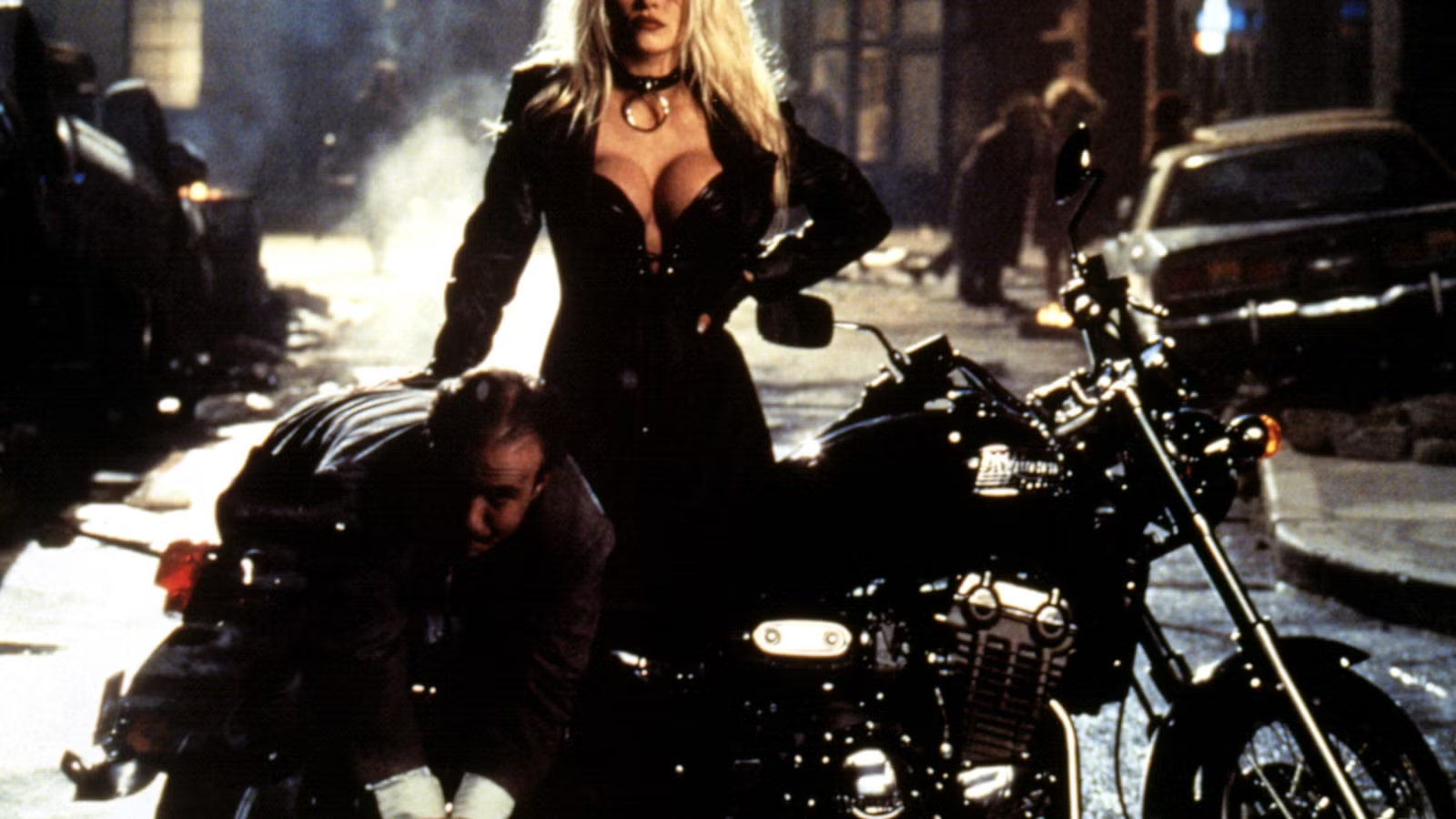
Barb Wire was released three decades ago on May 3, 1996. It was directed by David Hogan, who is mostly known for directing music videos and was the second unit director of Alien 3 and Batman Forever. It was written by Chuck Pfarrer (Darkman) and Ilene Chaiken (The L Word). And of course, it stars Pamela Anderson as the titular character, a leather-wearing, perpetually cleavage-exposing bounty hunter who owns a bar named the Hammerhead.
Barb Wire began as a character from Dark Horse Comics debuting in 1993. She lives in an alternate timeline where aliens landed and began experimenting on people in 1931, then a nuclear accident in 1947 merged with the alien tech, which gave lots of people superpowers. Fast forwarding to the 1990s, bounty hunter/vigilante Barb Wire operates the Hammerhead in a city called Steel Harbor while America is in the throes of its second civil war.
The film adaptation nixed all the alien and superpowers stuff. It also set its story not in an alternate timeline, but in a dystopian future of 2017, where America’s second civil war is raging and Steel Harbor is the “last free city.” Barb is now an ex-freedom fighter who, despite her proclaimed, self-interested neutrality, eventually ends up aiding the resistance against America’s now-facist government.

Really though, Barb Wire — with its bad acting, quippy-yet-unfunny dialogue, and thin plotting that borrows very heavily from Casablanca — reads as little more than a veiled excuse to show off Anderson’s physique.
While it was a success in that regard, it was a failure in every other way. Barb Wire bombed at the box office, failing to even match its $9 million budget. From a 2026 perspective, it also reads as a failure, being nothing more than a cheesy ‘90s sexploitation film. And while it stars a female badass, it still manages to be terribly sexist for how all the male characters regard Barb as a sex object and how the dialogue almost always invites their objectification. (Except when they call her “Babe,” she hates that.)

Yet one thing about the movie seems to take on a bit of extra meaning in 2026. The America in the film is literally in its second civil war and the American military officers in the movie are depicted in uniforms that unmistakably resemble Nazi uniforms. These fascist officers raid businesses (like the Hammerhead) and round up anyone seen as part of the resistance. Meanwhile, Canada is depicted as America’s sane, stable neighbor. Members of the resistance flee north for safety, and Canadian money is regarded as more stable than American dollars.
In 1996, such an America seemed utterly absurd and the movie was not at all a reflection of where the country was or seemed to be going. The civil war element came straight from the comics and the Nazi elements (which weren’t in the comics) were likely just another thing to borrow from Casablanca. Also, Americans moving to Canada, or even just having a desire to do so, was not nearly as commonplace as it is today. But in 2026, America’s divisiveness has reached a multi-generational high and facism seems to be in vogue with a good chunk of the American electorate, which makes the dystopian future depicted in Barb Wire seem like a much more possible future for America.
About the Author