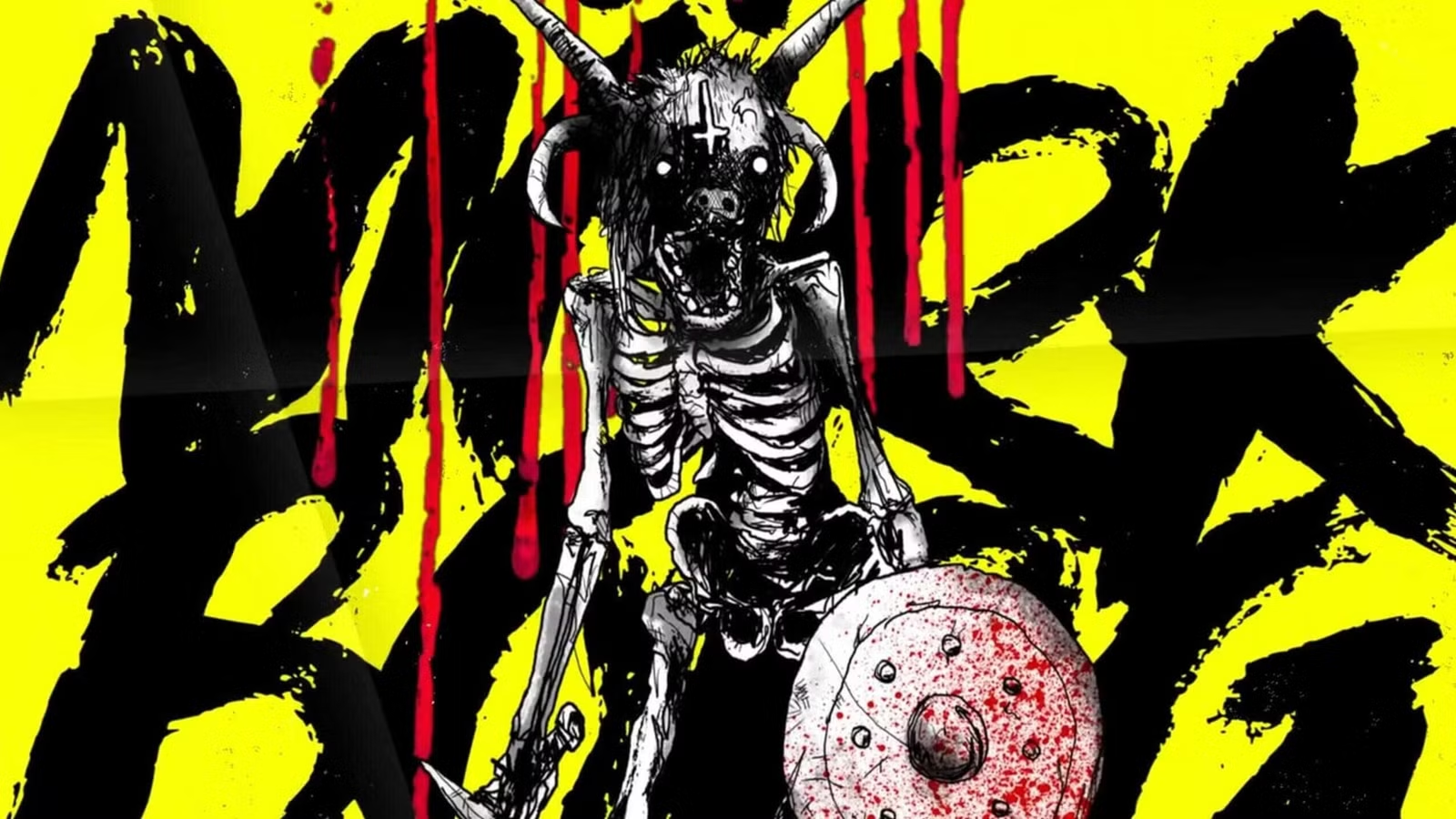
If you ever played Dungeons & Dragons and thought “this game needs more black metal,” then you should probably check out Mörk Borg, the apocalyptic fantasy RPG created by Pelle Nilsson and Johan Nohr in 2018, which quickly became an indie sensation. I’ve owned the main Mörk Borg book for a while now but haven’t had a chance to play it until now. I recently sat down as a player at a local TTRPG meetup, joining a table playing Dukk Börg, a spin-off of the game set in a dark and twisted version of the DuckTales universe. Yup, Mörk Borg is weird like that.
The game’s Third Party License allows fans to create and publish their material based on the Mörk Borg system (but it’s hard to use this word to describe such a simplified set of rules), and the good people at Gem Room Games decided to use that freedom to please the segment of the TTRPG fandom that both loves Mörk Borg’s doom metal vibes and at the same time fondly remembers sitting in front of the TV to watch the ludicrous adventures of Scrooge McDuck and his family. That segment is bigger than you might think.
Despite embracing the silliness of DuckTales, Dukk Börg does not forget its roots. Like in the original game, characters are not created to last. Mörk Borg and its many clones stand out because the gameplay experience is fast and unforgiving: You’re not playing mighty heroes blessed with supernatural prowess, but desperate survivors in a dying world. Which translates to: Don’t get too attached to your character, because chances are you’re going to be rolling a new one soon. I experienced this firsthand during that Dukk Börg game, and it changed the way I look at character death in D&D too. This game is not ducking around.

We played the starter adventure “The Aeonian Citadel,” which sees your gang of human-duck hybrids infiltrating the mysterious fortress where Skruj (this world’s version of Scrooge) resides. The whole romp is a funny satire of corporate greed, with Skruj using money to fuel his dark magic, and a horde of corporate duck drones caught in this horrific machine. To beat Skruj, you need to first attack his money by finding three weaknesses (one being Steamboat Willie, trapped in a vault because his IP has expired). My group fared surprisingly well — not least because I beat one of Skruj’s nephews half to death and dragged him along as a hostage — until we realized that we missed important things in the lower levels of the citadel. At the top, we were staring down into the abyss that held Skruj’s mountain of gold at the bottom. As we had just stolen a set of “golden parachutes” meant for the company’s executives, I thought we could simply jump down and glide to the bottom. The game master asked me to roll, and I had a good stat for this, but I still failed. No sweat, I could use one of my Omen points for a reroll…and I rolled a one.
In Mörk Borg, Omen points are a resource characters can use to get a reroll, decrease damage suffered, or lower the difficulty of a check.
In the next scene, three humanoid ducks lay splattered over a mountain of gold, and three players were rolling for new characters. However, this didn’t ruin the session at all. We just made up a quick, ridiculous introduction for the new team and picked up exactly where we left off. In this type of game, the main goal is to get to the end — of the adventure, and sometimes of the world itself. One of the most interesting mechanics in Mörk Borg is a “doomsday clock” that can move forward at the start of each day. On a roll of one on a pre-determined die, a “misery” occurs. When this happens for the seventh time, the world ends, likely catastrophically and painfully.

This gives the game a sense of finality that applies to the characters too. It takes ten minutes to make one, and everything is randomly determined with rolls. It’s the opposite of Dungeons & Dragons, where players build their characters carefully, thinking of synergies, class options, play styles, and so on. In D&D, you understandably grow attached to your characters through role-playing and story development. The death of a character is a big deal, or at least it should be. As a DM who loves focusing on story and encourages character development, I tend to shy away from killing characters. I admit that I’m guilty of skewing rolls in the players’ favor when things look too dire, or at least I always give them a way to avoid death. But long before I looked at Mörk Borg, I had been wondering if this was the right approach.
The rise of the Old School Renaissance in TTRPGs (a movement that looks back at the early days of the genre to recover “old school” mechanics and play styles) made this debate quite relevant. Games like Mörk Borg, Dungeon Crawl Classics, or Shadowdark make character death a much more common occurrence, while DMs who keep playing and enjoying first edition AD&D boast of how ruthless their games are. Meanwhile, D&D 5e and its 5.5 expansion give downed characters three death saving throw rolls, on top of an abundance of healing spells and abilities, plus easy access to resurrection.
In D&D 5.5, many spells can bring characters back from death with little to no cost. The level three spell Revivify requires a diamond worth 300 gold pieces, while level five’s Raise Dead requires a similar gem worth 500 gold.
So, who’s got it right? In my opinion, it all boils down to stakes. The shadow of death in an RPG makes players feel more about their characters and what’s happening to them. This can bolster both gameplay and storytelling, and unfortunately, current D&D rules work against this, or at least they require the DM to put in some extra effort to keep the players on their toes. However, the indie games mentioned above don’t necessarily nail the solution either. When characters are extremely disposable, it’s hard for a player to think of them as anything more than a set of stats on a piece of paper. “Don’t get too attached” is not exactly the best recipe for immersion.

Overall, I tend to have a syncretic approach to TTRPGs. I mix and match the elements I like, often modifying them to suit the needs of the moment and, more importantly, learning general lessons that can be applied in any context. I had fun playing Dukk Börg and toppling Skruj’s capitalistic nightmare after plummeting to death in the same session, but I also didn’t like not caring at all about my character. Going back to my main D&D game, I will be more ruthless with my players and no longer think of character death as something to avoid at all costs. Now, I have to come up with a coherent in-world reason why diamonds don’t exist in my campaign. Maybe a greedy humanoid duck monster has been hoarding them all in a vault…
About the Author