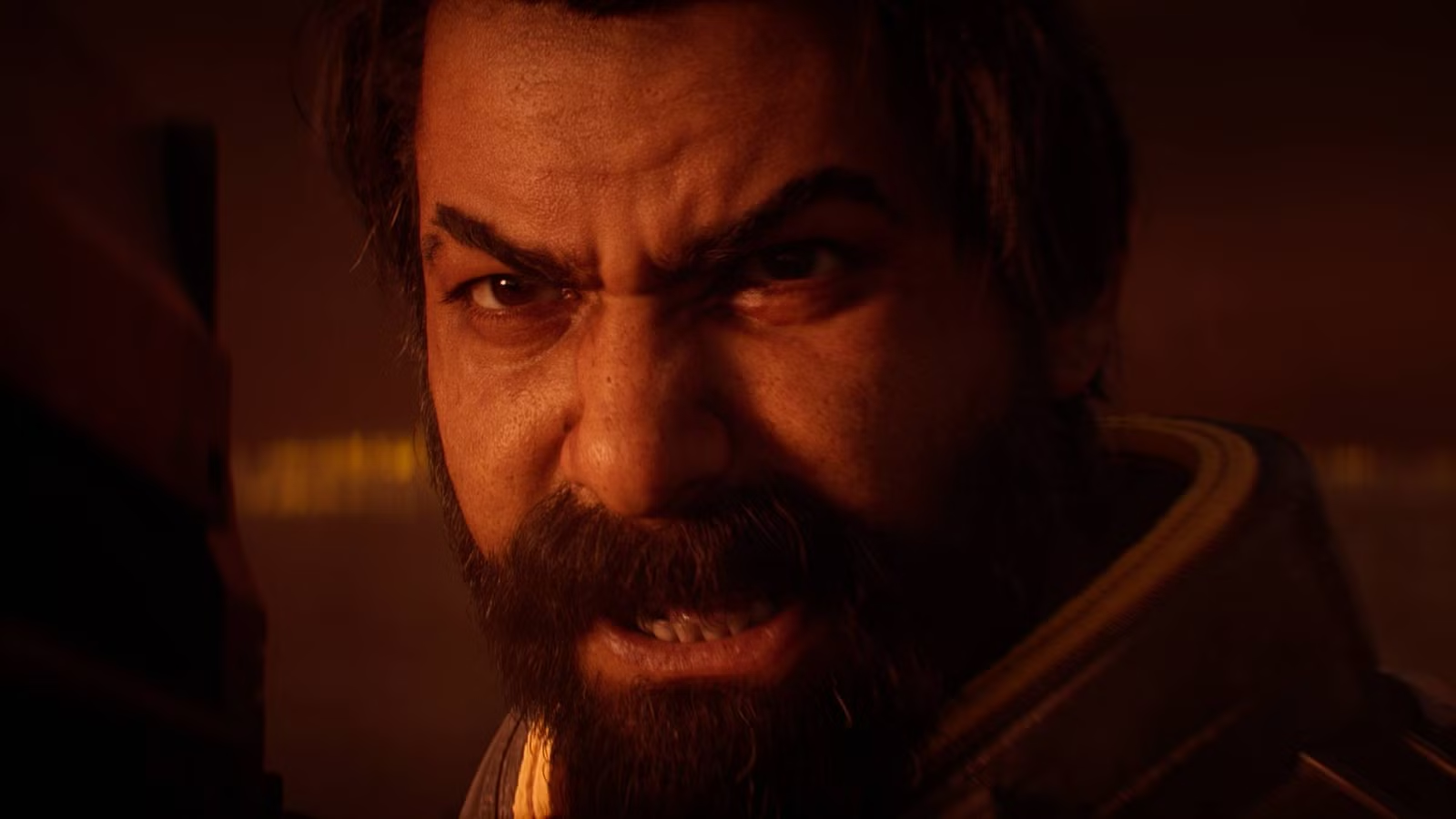
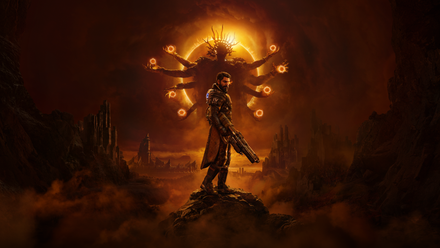
Arjun Devraj, the protagonist in Housemarque’s latest roguelike Saros (sort of), is a man on a mission. Early on, we learn he is searching for someone called Nitya. He knows that she came to Carcosa before him, and despite all signs pointing to her being dead since almost everyone else who came to the alien planet suffered the same fate, he has a gut feeling she’s still alive.
[Ed. note: This article contains spoilers for the story, ending, and secret ending in Saros. Read on at your own risk.]
Saros sands down Returnal’s challenging formula into a power fantasy
Housemarque’s latest shooter tries to iterate on Returnal with mixed success
However, Arjun is part of Echelon IV, the fourth expedition sent by Soltari to mine lucenite, Carcosa’s precious resource. His crew — Jerome, Tarn, Sheridan, Kayla, and Stack — is all slowly succumbing to the mind-altering effects of the mysterious planet, and they need his help. Each time Arjun dies in the field and returns to Passage, the Echelon IV base, the situation is increasingly dire.
In theory, Arjun has a choice to make: stop searching for Nitya, someone who could be long gone, and help his longtime allies, or push on and tackle the trials the planet has to offer. The game doesn’t let the player make that choice though. Arjun doesn’t consider, even for a second, that he should do anything except search for Nitya, who we eventually learn is — or was — his lover.
This selfishness runs through every action Arjun takes in Saros. As the story progresses, we learn that he wasn’t the best partner to Nitya. It’s heavily implied that either he was unfaithful, or sought comfort after Nitya left, with someone called Sebastian (more on him later).
In one flashback scene — the only one where the player actually controls Nitya — Arjun is hungover on the sofa; dialogue between the two implies he has an alcohol dependency. When Nitya claims he reminds her of his father, Arjun’s stern response raises red flags. Shortly after, when she decides she’s leaving him, he behaves in an emotionally manipulative manner while begging her to stay.
Despite Nitya clearly ending their relationship, Arjun behaves like a typical man. Of course she made the wrong decision. Of course he can win her back. Of course he’ll be better going forward. He just has to find her and make her understand. Nitya embarked on the Echelon I mission, while it’s implied the earliest Arjun could join is Echelon IV. With the funky time manipulation happening on Carcosa, it’s not clear how long it’s been for either of them.
As is revealed in the Saros secret ending, Nitya found solace with another member of her crew, Kiira. When Arjun learns this, he says “I didn’t know. I thought she needed me.” Ignoring the irony because he’s the protagonist of the game, his reaction gives enormous ‘main character energy,’ since he’s convinced himself he’s the only way she could be happy.
Then there’s Sebastian. From the start of the game, Sebastian has tended to the plants in Passage, and Arjun can talk to him at various points about what’s happening. There’s a framed photo of the pair on his desk. However, Sebastian is never referenced by the rest of the Echelon IV crew, so it quickly becomes obvious that something is amiss.
It turns out that Sebastian is a figment of Arjun’s imagination and isn’t really on Carcosa with them. Flashback scenes throughout the game imply the two shared a hotel room. Later, during the secret ending, we learn Arjun either killed Sebastian or was somehow responsible for his death. As Sebastian lay dying against a wall, he asks Arjun what he was to him. “You were nothing,” came the response. Police sirens grow louder in the background, and when the final scene in the secret ending comes to a close, they reappear, as if they’re chasing Arjun no matter where he goes.
Arjun spends all of Saros running away, under the guise of being the hero to save the damsel in distress. Joining Echelon IV and traveling to Carcosa could’ve been his opportunity for redemption, proving himself worthy by looking after the people around him who needed his help, but instead he continuously disregarded their safety and wellbeing in favor of his selfish mission.
It’s also not lost on me that you’re playing as someone who works for a private corporation that wants to colonize an alien planet solely for its own benefit. Primary, Echelon IV’s robot commander a la Hal 9000, is hellbent on collecting as much lucenite as possible for Soltari. Ironically, Arjun often argues with Primary, saying his mission to find Nitya is more important. On paper, saving a life is absolutely more worthwhile than collecting resources to make the rich richer, but he’s completely oblivious to the bigger picture.
Housemarque says Saros is easier because no one could beat Returnal
You won’t be left for dead in the Crimson Wastes this time around
Playing as a selfish person isn’t new to video games. In The Last of Us, Joel extinguishes hope of a cure for the virus that has created the post-apocalyptic world they live in to save Ellie’s life. Where it’s tough to see the redeeming features in Arjun Devraj, the player is left conflicted at the end of Naughty Dog’s epic because Joel has proven himself to be likeable and most importantly, relatable. Could we, as humans, say with confidence that we wouldn’t do the same in his shoes?
Another example is Henry in Firewatch, who also takes a job to escape his troubles, specifically his wife’s early-onset dementia. Befriending Delilah allows him to avoid responsibility, and the seemingly unexplainable events happening around the pair provide an outlet for his focus and attention. Henry isn’t a good person, but he has at least somewhat understandable reasons, something Arjun is lacking.
Rahul Kohli’s performance in Saros is phenomenal, and Arjun Devraj is sublimely written as what is essentially a playable villain. No matter which ending you consider to be canonical, neither is a favorable outcome for him. And he deserves both miserable fates: either living out his days as the King in Yellow, or being forced to relive the eclipse cycle on Carcosa time and time again.
About the Author