On Monday, GameStop astounded the world by revealing its intention to purchase eBay, a tech company worth many billions more than the video game retailer. The immediate question on everyone’s mind was how GameStop was going to afford such an enormous purchase. The answer, it turns out, is kind of the way that the company is staying afloat at all: Pokémon cards.
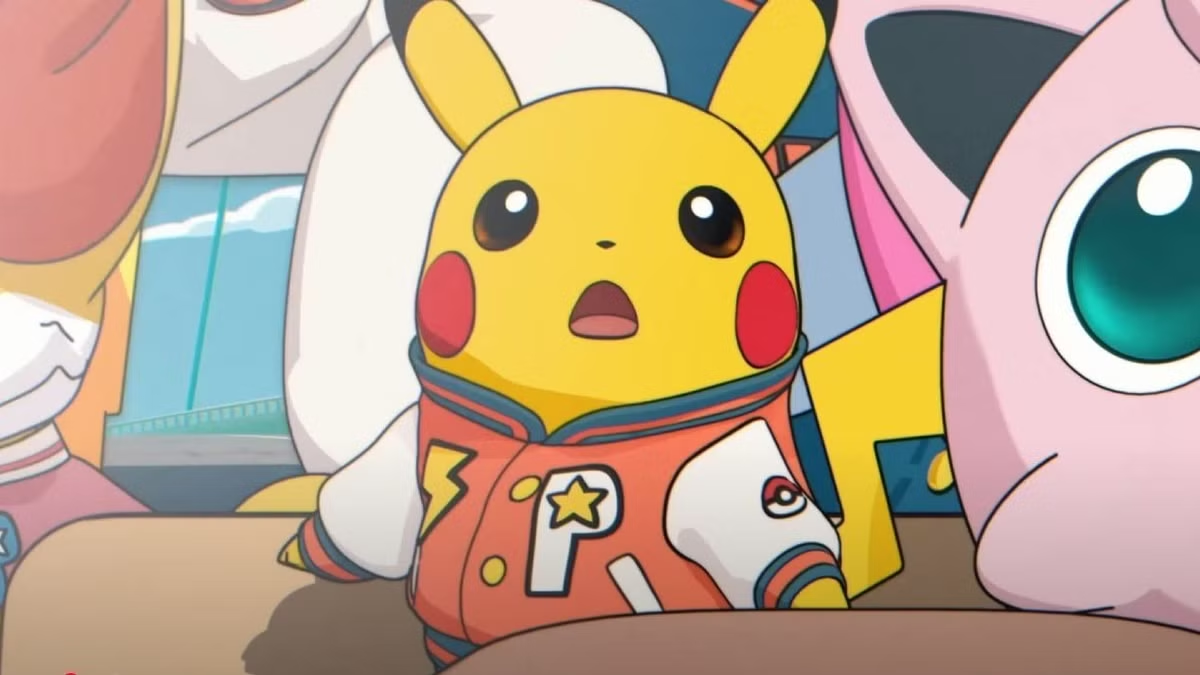
GameStop sells something called Power Packs, which are bundles of Pokémon cards that come in different tiers. The higher the tier, the better the chances that the pack will contain high-value cards. Critically, GameStop itself decides what a pack contains. Power Packs might sound shady, but the alternative is paying three to five times the manufacturer’s suggested retail price for any given Pokémon TCG product.
Previously, GameStop sold Power Packs in tiers ranging between $25 and $2,500. If a customer pulled something good, GameStop offered instant buybacks. GameStop does not offer market value for the resold cards, but the retailer does get rid of all the busywork of selling and packaging high-value cards. Now, the entire scheme is about to get even richer for GameStop, thanks to a new $5,000 ‘Neutronium’ Power Pack tier.
On a page highlighting the possible cards a customer can pull from Neutronium, GameStop displays chase cards worth anywhere between $26,000 and $68,000. All of these high-value cards, which include things like Charizard and Pikachu “grails”, are already graded either PSA 9 or PSA 10. The catch is that GameStop customers only have a 0.4% chance of ripping a pack that is worth over $40,000. 44% of all Neutronium packs are estimated to be worth somewhere between $3,000 and $4,000, according to GameStop.

Notably, since GameStop includes pre-sealed booster packs, the company could theoretically say a Power Pack is worth considerably more than what the pack actually contains. A vintage Pokémon pack can be sold for thousands of dollars, but that value is essentially Schrödinger’s Pikachu. The value comes from not knowing what’s inside. Once it’s opened, there’s a high probability the vintage pack turns out to be worthless compared to what it would fetch while sealed. Another consideration is that there’s no way to see a packaged card’s condition — which matters when a card’s value is determined by entities like PSA.
Add in the detail that GameStop takes a fee from every transaction on its platform, and Power Packs start feeling like a racket. Yet it appears to be paying off for the retailer, which announced in 2025 that it would be going all-in on collectibles. Purchasing eBay, one of the major platforms where collectibles are sold, would give GameStop even more data and control over the market.
To get there, GameStop has to raise billions first. We know that the company already has a war chest worth a few billion, and that the retailer has been promised an additional $20 billion from a bank. Even with all that cash in hand, GameStop still needs many more billions to pay the bill. The decision to launch $5,000 Power Packs a day after a disastrous interview in which CEO Ryan Cohen struggled to explain where the money would come from sure has curious timing.

Her multi-million dollar Pokémon card collection is unprecedented. It’s raising eyebrows.
Pokémon card hobbyists have never seen anything like the Jolina Gisèle collection, which spans 60,000 rare cards
About the Author