For anyone who’s been following Nicolas Winding Refn for the past three decades, he can be an … acquired taste. The Danish auteur possesses an abundance of style, but over the years, his work has veered from more straightforward crime thrillers (the Pusher trilogy, Drive) to genre-bending projects that move at a snail’s pace. (His 13-hour Prime Video miniseries, Too Old to Die Young, is incredible if you have the patience for it.) But if you want something that lands in a satisfying middle between Refn at his most conventional and Refn at his most experimental, it’s worth diving into his 2023 Netflix series, Copenhagen Cowboy.
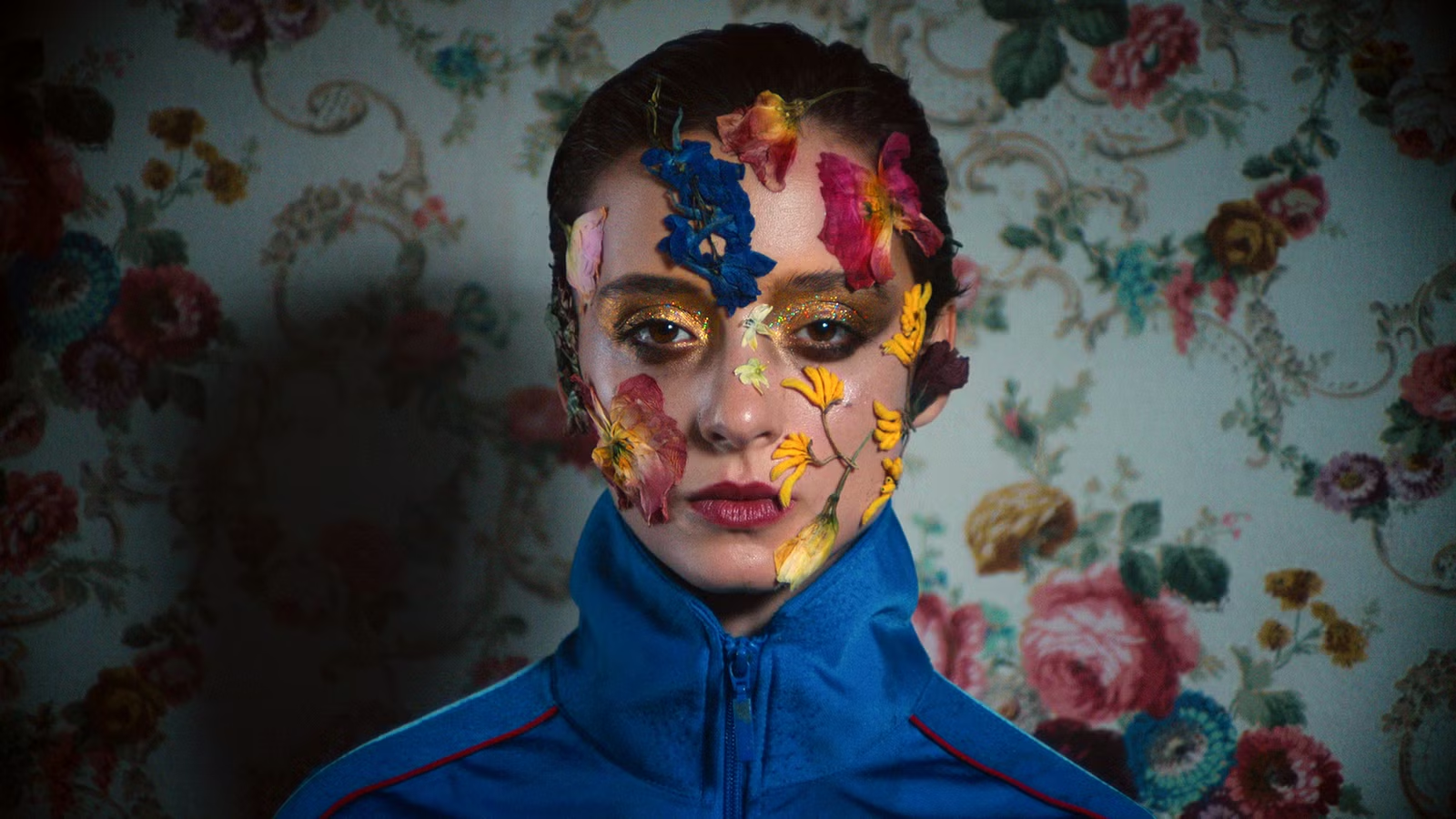
Returning to his native Denmark for the first time since the Pusher trilogy, Copenhagen Cowboy is about an enigmatic loner named Miu (Angela Bundalovic) who is treated as a “lucky coin” and passed between different organizations in Copenhagen’s criminal underbelly. Basically, she has some vaguely defined psychic powers that bring good fortune to those around her, but if you get on her bad side, your luck will just as quickly run out. Over the course of six enchanting episodes, Miu drifts through a series of increasingly surreal encounters: a brothel run by Albanian gangsters, a Chinese restaurant masking organized crime operations, and the orbit of a wealthy family that may or may not have vampiric origins.

In another filmmaker’s hands, all of this might sound propulsive, like the John Wick franchise with a paranormal paint job, but Refn isn’t interested in action as much as atmosphere.
The best way I can describe Copenhagen Cowboy is that it operates on dream logic. Characters cryptically talk to each other at 0.25 speed, there are agonizingly slow 360-degree camera pans that demand the viewer to savor every little detail, and the synth-heavy Cliff Martinez score wouldn’t seem out of place in a nightclub. Combine all of that with a sumptuous, neon-drenched neo-noir aesthetic, and Copenhagen Cowboy feels like getting caught in a trance at three in the morning where your sleep paralysis demon is a fashion designer.
I can’t blame you for finding these qualities too off-putting, but for anyone who loves Refn at his most self-indulgent (see: me), it’s fun going down the rabbit hole. Miu, who speaks as little as Ryan Gosling’s character in Drive, has been described by Refn as a “female evolution” of his usual brooding protagonists, defined more by their effect on the world than by any interior psychology. How did Miu get her powers? Is she even human? Why does she kind of resemble Agnes Varda? I couldn’t say, because things like “plot” and “character development” aren’t exactly priorities in the Refn-verse.
If Copenhagen Cowboy feels like Refn fully leaning into his instincts, that’s because it is. Everything — the color design, the near-silent performances, the hypnotic camera movements — is a distillation of the style and languid pacing Refn has refined since Only God Forgives, his polarizing follow-up to Drive. From what we’ve heard about his latest film, Her Private Hell, it should follow in that tradition. Early reports indicate that Her Private Hell, which is set to premiere out of competition at Cannes, could be Refn’s first slasher, following the production of a Barbarella-like movie while a serial killer known as the Leather Man is on the prowl. I couldn’t be more locked in.
Post-Drive, Refn seems unconcerned with whether his rhythms align with contemporary expectations, carving out a niche as a cult auteur. Copenhagen Cowboy is where those impulses feel most fully realized on the small screen. The result is one of Netflix’s strangest and most overlooked originals: a spellbinding supernatural crime saga that’s almost algorithm-proof in the modern streaming landscape. The series demands patience, a tolerance for ambiguity, and a willingness to surrender to its trippy wavelength. But if you’re able to meet it halfway, Copenhagen Cowboy becomes mesmerizing in a way that only Refn can deliver.
About the Author