People encountering the anime series My Dress-Up Darling entirely through online excerpts, as a series of screenshots and out-of-context video clips, may assume it’s an overly horny cosplay show full of suggestive poses and enough fan service to classify it as full-on “ecchi.” That impression isn’t wrong, exactly. But it’s incomplete. Seeing those elements divorced from the broader context, you’re missing out on the show’s real magic. My Dress-Up Darling shines in the quiet moments between the fan service, where it becomes a touching story about making art, taking risks, and learning how to be seen.
My Dress-Up Darling arrives on Netflix Saturday, April 25. For any anime fans looking for a heartwarming slice-of-life teen romance, you’d be hard-pressed to find anything that’ll make you squee more.
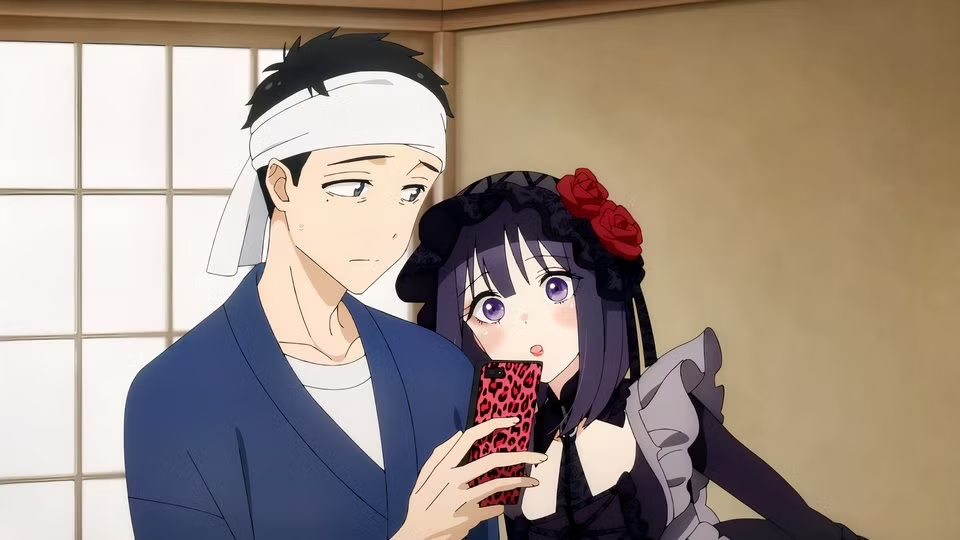
Wakana Gojo is a kind, deeply shy teen who spends his school days silently watching his classmates live their lives. While he isn’t exactly bullied, Gojo is a pushover who constantly takes the path of least resistance, even when it leads to his own suffering. He’ll do anything to make other people happy. That same sentiment applies to his artistry. After school, Gojo goes home and changes into his samue, a robe-like traditional Japanese work garment, to craft Hina dolls with his grandfather. These ornate dolls are replicas of royalty from the Heian period, and are often gifted to protect girls from evil spirits. Some are even passed down as family heirlooms.
The shop Gojo runs with his grandfather is firmly rooted in Japanese historical tradition in a way that few people in Gojo’s world seem to respect, let alone cherish. It’s the sort of place Gojo’s classmates vaguely remember as the site of a childhood field trip — boring, old, and lame. Gojo carries a deep sense of admiration for his grandfather’s artistry and aspires to be just like him, but he also carries a bit of shame and embarrassment for all of the above. He cares more about his art than about what other people think of him, but he’s still a teen figuring out his place in the world, and he lacks the confidence to embrace his skills and passions.
Enter the enchanting Marin Kitagawa, the “It” girl at school. She’s effortlessly beautiful, popular, and outgoing — she even works as a model! The tips of her blonde hair are dyed pink to match her eyes. Neither of these are natural: They’re stylistic choices. She also has a chaotic assortment of ear piercings that make her seem very, very cool.
In many ways, Gojo and Kitagawa read like stereotypical protagonists in a romance like this. The relentlessly energetic “genki” girl brings the shy “dandere” boy out of his shell. But My Dress-Up Darling complicates that familiar premise by establishing its thesis within the first 10 minutes. While chatting with her girlfriends, Kitagawa explains why she recently rebuffed a handsome guy trying to flirt with her after he poked fun at the anime charms on her bag: “Making fun of the things people like is not hot!”

You know what is hot? Liking things. Having good taste and passionate interests that you lose sleep over and dream about every day, the ones that come to define the way you live your life. You know what’s even hotter? Supporting your friends in their pursuit of these passions.
Gojo and Kitagawa’s worlds collide when she realizes he knows how to sew. She’s desperate to cosplay as her favorite character from a video game, but she needs help to pull it off. Gojo would do anything to help someone, but he’s also a perfectionist with incredible attention to detail and the kind of all-consuming laser focus that lets him block out the rest of the world when working on the task at hand. There are no half-measures in Gojo’s world, so when he promises to help Kitagawa, the results are an overwhelming success that inevitably leads to more and more cosplay projects.
The series establishes each new cosplay project as a self-contained narrative arc. Over time, Gojo and Kitagawa’s friendship grows and blossoms into something deeper. Meanwhile, they’re constantly making new friends in the form of other cosplayers, photographers, and costume designers from the wider community. At every step, My Dress-Up Darling embraces the warmth of radical acceptance, and that makes it such a joy to watch. The only thing the show’s protagonists perceive as weird is the people who call other people’s interests weird.

Yes, the show’s warmth does simmer into full-on heat with some of the more risqué cosplay outfits and randomly horny hijinks, enough that you wouldn’t want someone to walk in on you watching it, but these moments don’t even really feel like shameless fan service. Instead, the show reads as sex-positive. It’s all part of a larger story about what it means to be fully seen by someone who doesn’t just accept what you love, but celebrates it with you.
My Dress-Up Darling season 1 will be available to stream on Netflix on April 25. Both seasons 1 and 2 are currently available on Crunchyroll.
About the Author