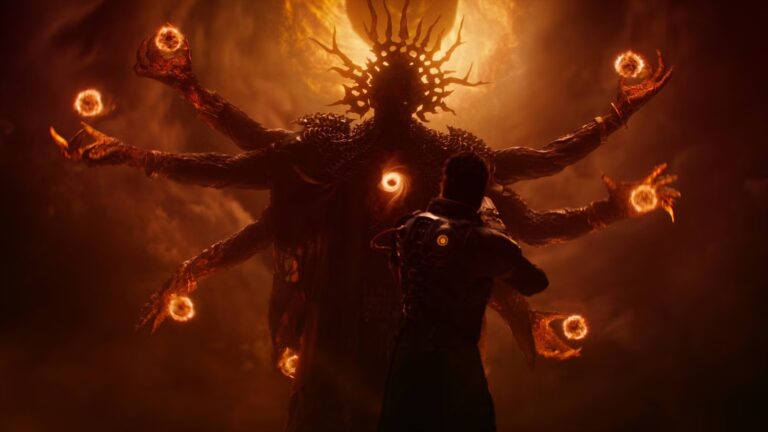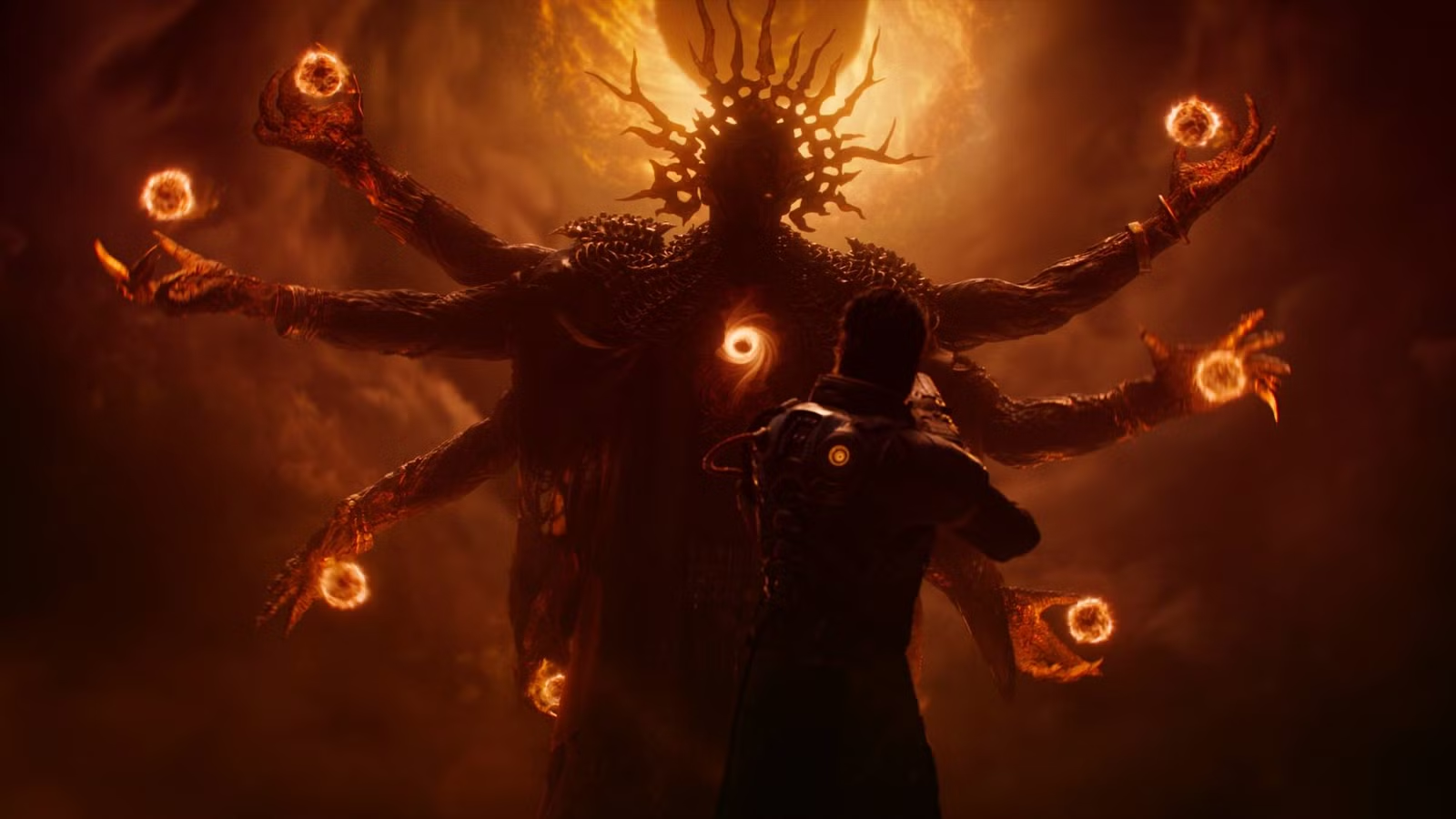
Saros isn’t a direct sequel to Returnal. Lore-wise, they don’t share a universe, and although there are similarities in the premise, it’s a spiritual sequel at best. In terms of the gameplay, however, it’s a clear evolution of the premise: more weapons, biomes, and bosses, alongside more ways of playing thanks to the world modifiers. The action is almost identical, giving players another third-person bullet-hell shooter on an alien planet with many of the same abilities.
However, the structure of Saros leaves a lot to be desired. It frames itself as a roguelike, and you can play through most of the game thinking it is, especially since Returnal was. After all, it has all the key elements, right? Repeatable runs with gear and stat boosts you find on each venture, procedurally generated biomes, difficult bosses…

Technically, sure. The problem is, Saros would fare much better as a typical action game, because the story simply doesn’t fit the roguelike structure whatsoever. For a roguelike to work, you should be able to, in theory, get all the way to the final boss on your very first run. Saros doesn’t let you do that. It brings you back to Passage, the Echelon IV base, at the end of practically every biome.
Even when you’ve beaten the entire game, completing a full run from the first biome to the last is impossible. You can get approximately two-thirds of the way, but once you beat one of two specific bosses (depending on the path you choose two biomes before the end), you’re forced to return to Passage. When you’re back there, you can’t resume a run; you must start over, albeit from a biome of your choice, but your accumulated power and artifacts are all reset.

Saros also implements a skill tree, something Returnal did not have. Lucenite, the resource used to enhance your power — or proficiency, to use the in-game lingo — is also retained and can be spent on permanent upgrades when at Passage. You can also find Halcyon, another resource, and spend it on new abilities and stat boosts. This reduces the number of interesting upgrades to find while exploring, since most items are merely resources to spend later. Due to almost everything you find being a stat boost or alteration too, there isn’t much potential to have wild, overpowered runs and combos like you’ll find in other games in the genre.
Housemarque says Saros is easier because no one could beat Returnal
You won’t be left for dead in the Crimson Wastes this time around
Roguelikes also typically offer a formidable challenge. While Saros does at first, the difficulty can be dialed down significantly after beating the second biome and unlocking the Carcosan modifiers system. This allows you to make the game’s difficulty entirely trivial by enabling damage and armor buffs. The catch is that you need to balance them with negative traits, but their effects are negligible compared to the positive traits.

Allowing more people to enjoy a game is absolutely a good thing, but Saros accomplishes that by overcompensating too far in the other direction. While this system is entirely optional to engage with, allowing players to micromanage difficulty through balance tweaks removes the sense of satisfaction and doesn’t encourage the player to grow and improve.
If Housemarque had abandoned the premise of a roguelike for Saros and instead retained the same style of gameplay, with traditional checkpoints, longer biomes, and no Groundhog Day-esque death loop, it would have a strong, narrative-driven third-person shooter on its hands. As it stands, anyone going into Saros expecting something they’ll want to play over and over and over again, may be disappointed. As impressive as the combat is, there’s little reason to stick with it beyond rolling credits (twice, once you’ve unlocked the secret ending!).
About the Author