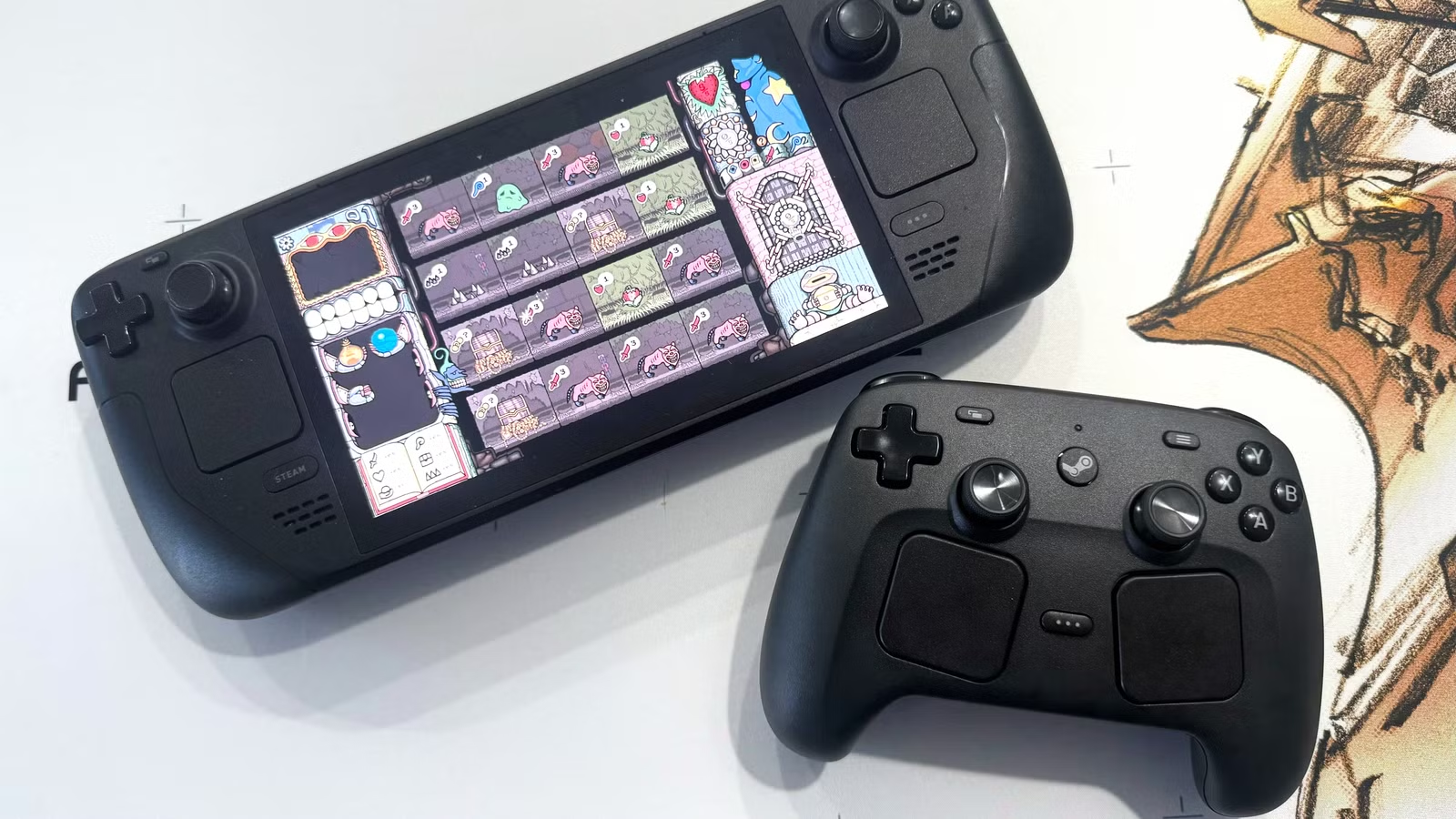
A decade ago, Valve tried to reinvent the video game controller as we know it. The first iteration of the Steam Controller aimed to bring a PC gaming experience to a gamepad form factor. It was, perhaps, a little too high concept, as its giant touchpads and single-joystick design took a lot of getting used to. It didn’t exactly catch on despite selling one million units, and Valve moved on with its hardware ambitions. But the dream of making a better PC controller never died.
“There was not a point between 2013 and today where we were not working on controller inputs,” Valve programmer Pierre-Loup Griffais told Polygon in a video interview, alongside hardware engineer Steve Cardinale.
The three of us met up to talk about Valve’s decade-in-the-making return to the gamepad. The company’s second attempt at the Steam Controller will be available to order starting on May 4, coming to market ahead of the upcoming Steam Machine and Steam Frame. The new version is much more traditional than Valve’s previous attempt; it looks like your standard gamepad, but with two haptic touchpads below the dual joysticks. It seems like the obvious decision now, but there’s a reason it took over 10 years for Valve to crack it. Making a video game controller is much more complicated than it seems.

For the first Steam Controller, Valve aimed to solve a very specific question: How do you replicate the feel of a mouse with a PC controller? A joystick doesn’t provide the same level of precision, but a gamepad format is more appealing from an ergonomic standpoint. How do you fuse the two? An idea for a controller was born, but one that targeted a niche audience.
“The first Steam Controller was very much a peripheral meant to play PC-only games,” Griffais said. “It wasn’t really meant to replace your normal controller. We were very much envisioning that someone would have an Xbox controller for games that are designed for a controller and a Steam Controller for games that are designed for PC mouse and keyboard.”
Valve pulled that off, but it wasn’t the most elegant solution to the problem it wanted to solve. The Steam Controller’s appeal was fairly limited to PC enthusiasts and didn’t become a household name like the Xbox Wireless Controller. Still, Valve saw potential in the idea; it just needed to bring its high-level thinking into something more familiar to players.
“What we saw is that there was an opportunity to actually make it into a controller that’s just compatible with controller games, where all the controller inputs are there where you expect them, and then to still have all these features,” Griffais said. “That’s kind of the exercise that we went through for this Steam Deck, which included all the elements from the original Steam Controller, but also made it into a first class gamepad that acts like you would expect a gamepad would, without having to worry about what those extra inputs are doing. And the Steam Controller, the 2026 version, is very much a continuation of that.”
We know the look is not something that’s going to endure…
More than anything, the Steam Deck was the catalyst for the new Steam Controller. The idea to revisit the controller came after Valve created the handheld PC’s button layout, something it felt like it could replicate on a gamepad. Steam Deck players had also noted that they were using third-party controllers to play their handhelds when they were docked to a TV, so it just made sense to create a controller that was more consistent with the device.
This time, Griffais said that the goal was “very much to not reinvent the wheel.” That was easier said than done. Valve created hundreds of 3D-printed prototypes, and more than 30 fully usable prototypes. There were a lot of elements that it had to get just right. The hardest challenge? Making something that just felt right in players’ hands.
“From an ergonomic standpoint, there was a stage where it felt like we were reinventing [the wheel] for a little while, because we were like, how do we take all this stuff that we did in Steam Deck?” Cardinale told Polygon. “We generally know the loose layout and where the thumbsticks are relative to the D-Pad. How do we get that into a controller form factor and feel good in your hand? We did a lot of work on that in Steam Deck, but the controller is a totally different form factor. It’s smaller. Your hands naturally come together differently when they’re here. So we had to do a lot of work on the ergonomic side to make sure that the controller felt comfortable, natural in your hand.”

It doesn’t look especially comfortable at a glance. It’s noticeably boxy compared to your typical gamepad. The touchpads, which are larger than the ones on the Steam Deck, add a lot of space to the center of the controller. Feeling is believing, though. It’s a remarkably comfortable controller that’s smooth in the hands. When I mentioned my initial reaction to the team, they noted that they’re used to hearing that.
“I think it’s a direct symptom of our priorities. We’re trying to make sure it’s ergonomic first, and we know the look is not something that’s going to endure,” Griffais said. “The experience that you want to endure is actually what it feels like after you’ve played it for a few hours.”
Ergonomics aren’t just a matter of making grips that feel nice to hold. Button layout is paramount too, and Valve had a major X-factor to deal with on that front. How do you handle touchpads? After all, that was the most alien part of the original Steam Controller. It may seem like Valve solved that by aping the Steam Deck, but the process was actually far more complex.
“One of the biggest things that took the longest time was the trackpads,” Cardinale said. “Because if you look at them, they’re not just straight up and down, left and right, right? They’re clocked and canted, because that is actually the more comfortable position we found from everybody who used them. It gives you more usable area. It feels more natural. That was just from a lot of iterative changes and prototyping and learning. And you really just have to do that and study both with external and internal people.”

Ergonomics are only the first part of a difficult balancing act. You also need to find a way to pack in as many features as you can, while keeping the price down. Do you want the most high-end buttons? That’s going to cost you. Looking to create a very long-lasting battery? That raises the price too. That’s partially why Valve didn’t try to make its own version of the Xbox Elite Wireless Controller. The Steam Controller has back buttons, but there are no trigger locks, swappable parts, onboard volume controls, or any other bells and whistles you tend to find on third-party controllers.
“We don’t want to overburden the controller with a ton of extra features that are going to drive up the cost,” Cardinale said. “We wanted to achieve the best possible value for our customers and gamers, so that they can have a controller that doesn’t cost twice as much, and they’re going to only use 20% of it. We want it to be something that delivers a good value for what it is for everybody.”
Thumbsticks were a big part of the calculus. Players are very particular about their joysticks these days, and for good reason. Stick drift has been a serious problem for controllers like the Nintendo Switch’s Joy-Cons. There’s been a consumer push in recent years for hardware manufacturers to embrace Hall Effect, a magnetic joystick solution that results in less wear and tear. Valve didn’t go for Hall Effect on the Steam Controller, but a lot of careful thinking went into that decision.
“This controller has TMR thumbsticks,” Cardinale said. “They’re a magnetic tensing thumbstick like Hall Effect sensors, but they’re different technology. They have all the same benefits. It’s more drift resistant. We have a smaller true-zero dead zone. They’re more responsive, essentially. With the added benefit that it’s lower power than Hall Effect, so we don’t have as big of a battery life hit. Great things that we want to add to this controller. We just felt ready with this controller from a timing perspective, and where the maturity of the sensor is at, for adding it for this product versus Steam Deck.”
Reusing work is an important part of what we do.
The team did have to make some concessions to pull off the vision. The Steam Controller is only truly compatible with the Steam client and Steam Link. When you plug it into a PC, the computer treats it like a composite mouse and keyboard. Most PC gaming launchers will treat it as such too, making it unusable with most games outside of Steam. (You can still play them by adding them to Steam.) It’s the controller’s one weak point, but it was unavoidable if Valve was going to make something that had parity with the Steam Deck.
“To have a controller work out of the box on a PC or a console, you either have to be pretty much an Xbox or PlayStation controller,” Griffais said. “Which is something that the Steam Controller could have been, but then it wouldn’t really be the Steam controller. A bunch of these features are not things that are available through the standard APIs. We understand it’s a trade-off, and we’re continuing to do more work for it to be as seamless as possible to add non-Steam games and to benefit from all this stuff. We landed in a pretty good place there, but there would be limitations to what we’re able to do if we were working out of the box as an Xbox controller, for example.”

Griffais affirmed that the decision isn’t about locking PC players into a Steam ecosystem; the goal was to create more options for all players. But the reality is that Valve wants to create a consistent experience for its users across devices. That has become especially paramount with the popularity of the Steam Deck, and it will be even more important when the Steam Machine launches. The experience has to be seamless across every device, which is where the need for trade-offs comes into play.
“Reusing work is an important part of what we do,” Griffais said. “We also strongly believe in that for the work that we end up having a user do. So if a user is investing any time in the Steam input configurator because they want to have a configuration to play Factorio, or one of those complex PC games that’s just right for them, it’s really important that they can get to the Steam Controller and get the exact same experience that their configuration loads straight in. We have some similar things around, if you unbox a Steam Machine, you can put the SD card from your Steam Deck in there and you’re good to go from day one.”

The good news is that Valve’s hardware is flexible. As we saw with the Steam Deck, system updates can go a long way towards improving experimental devices. The Steam Controller is going to work the same way, as Valve has the ability to push updates to it. There’s a chance that it could find a way to make it compatible with the Xbox app or the Epic Games Store overnight, if that’s what players want.
“Updating things often and listening to customer feedback is very much at the core of how we function,” Griffais said. “I don’t think we could actually work very well without being able to do that. So everything about this controller is updateable: the firmware on the receiver and the firmware on the controller itself. While obviously we can’t do miracles with respect to changing the hardware as it shifts, we think that we have the ability to address any issues if they come up in the field. If we hear a lot of feedback around how some different method of connecting or some different UX would be desirable, we’re definitely prepared to roll out updates.”
In 2026, sometimes it can feel like the video game controller is a solved problem. Xbox cracked it over a decade ago and there’s no use in resisting standardization. The Steam Controller proves that isn’t the case. There are tons of tiny decisions that can reshape a controller for the better, but they need to be balanced with price, comfort, and battery life. The Steam Controller isn’t the be-all and end-all of PC gamepads — I’m sure Griffais and Cardinale would agree. But it does make a good case for why we should keep trying to refine the wheel rather than reinvent it.
“I think we knew what we were getting into, but it was still a huge amount of work to ship this,” Griffais said.
About the Author