Hidden amongst the film noirs and pulpy slashers on Prime Video, there’s an erotic thriller starring Michael Caine that’s a homage-borderline-remake of an all-time great horror classic waiting to be rediscovered. Although overshadowed by the bigger movies from the director (who Quentin Tarantino once described as “one of the finest directors of his generation”), it has a twist so provocative it’s a wonder that it hasn’t become as well known as Fight Club or Shutter Island.
Prime Video is by far the best mainstream streamer for finding genuinely interesting, genuinely old (i.e. pre-1990) movies. Through a mixture of their MGM purchase and some eclectic licensing, Amazon’s streaming service has a well-curated collection of lesser-known classics from big names ready to be uncovered.
I’ve long been a fan of Brian De Palma, the luminary of Lucas, Spielberg and Scorsese. Although more recently faded from view, De Palma is responsible for a filmography that rivals any of his fellow Movie Brats: Carrie, The Untouchables, Scarface, Carlito’s Way, Blow Out all in a 20-year span. Quentin Tarantino has praised him repeatedly over the years, in part because of his more underdog status. While promoting his book, Cinema Speculation, he explained:
“Everyone loves Spielberg and Scorsese, there was no question of me joining the club of the most popular guys, that’s not my style! Part of my love for De Palma came from the possibility of getting into trouble defending him, sometimes to the point of coming to blows.”
I’ll admit, my deeper Movie Brat watching has typically landed on the core trio, while my De Palma experience focused on those landmark pictures. As such, I assumed Tarantino’s admiration was about the swagger, the style. I took the claims of being a Hitchcockian inheritor to be one of method, not quite as literal to the point of co-authorship. And yet that changed with one of his B-movie thrillers.

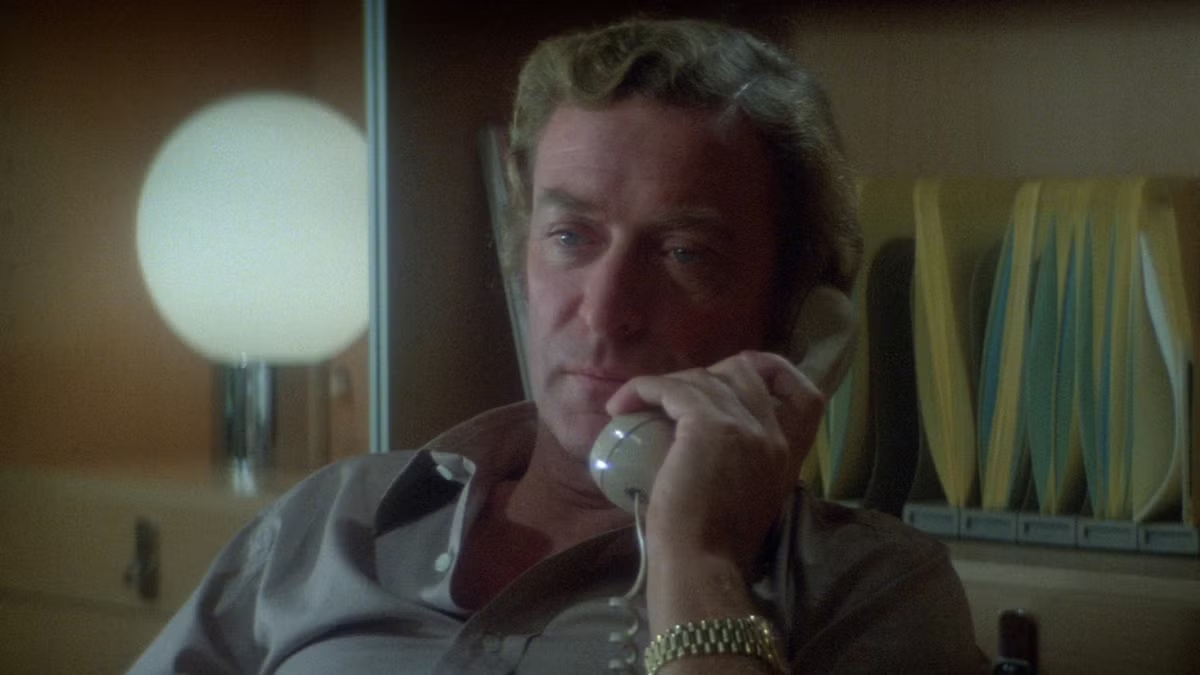
Dressed to Kill would have been called elevated horror if that term existed in 1980. It is a high-end slasher about a high-end call girl (Nancy Allen). She becomes the target of a scalpel-wielding blonde, heavily suggested to be Bobbi, a transsexual patient of psychiatrist Dr. Robert Elliott (Michael Caine). De Palma’s opening gambit is to bury the premise, spending the first forty minutes following middle-aged Kate Miller (Angie Dickinson), another of Elliott’s patients, before she is attacked in an elevator.
De Palma uses his favorite tricks to class up the material. His trademark split diopter, a shot where both sides show near and far in perfect focus with a dividing line in the center, is used for both chills and laughter.
Characters are literally framed: building on a nine-minute wordless scene in an art gallery, the film repeatedly presents the characters in physical and constructed frames.
And now, if you haven’t seen Dressed to Kill and want to experience its twists for yourself, I’d recommend jumping over to Prime Video and watching the movie. If you’re more impatient, the actual reveal scene is below.
So, yes. It’s Psycho. If the repeated shower scenes, end-of-first-act murder that flips the story onto the head of a new protagonist and psychiatrist explanation dump at the end don’t clue you in already, the finale reveals that Elliott is Bobbi, the killer. I was genuinely stunned, if only because I’m amazed I’d not heard of the film where Michael Caine dresses as a female killer.
The trans narrative is, as it was in Alfred Hitchcock’s original, a bit of a misnomer. We’re dealing with a psychosexual dissociative identity disorder (DID): the repressed other side of a man becomes violent when he gets aroused. Viewed 46 years later (and 66 years after Psycho), Dressed to Kill‘s trans panic approach is undeniably dated, although both directors seemed to understand the difference between sexual identity and mental illness.
There are two key evolutions in how De Palma approaches the underlying twist. First, instead of holding the star in a dress for the end, Dressed to Kill establishes the notion the killer could be a man in drag from the moment of the murder, and features multiple sequences attempting to explain the distinction between being trans and DID.
Second, the sexual drive of its killer is fronted. Psycho was incredibly transgressive for its time, pushing the limits of what violence could be presented on screen, but as with Hitchcock’s other explorations of sexual obsessions they had to be paired with repression. Dressed to Kill opens with Dickinson naked in the shower, and positions its heroine as an escort. Sex is front and center, charging every step.
On The Video Archives podcast, Tarantino called this sort of movie a “paraphrase remake“, one where the enough beats are similar that the enjoyment is heightened through the filter of knowing the hyper-specific tropes. This was the eye-opening element of the film: De Palma wasn’t using Hitchcock’s toolkit, he was actively remixing it.
Since watching Dressed to Kill, I’ve dug deep into the lesser lauded thrillers in his filmography. Sisters (on HBO Max) is Rear Window. Obsession is Vertigo. Body Double is both Rear Window and Vertigo.
It’s clear now that de Palma was in conversation with Hitchcock as much as he was influenced by him. Movies like Dressed to Kill, dated as the sexual politics may be, show how a director can connect to the past while making something firmly for the now.

- Release Date
-
July 25, 1980
- Runtime
-
104 Minutes
- Director
-
Brian De Palma
About the Author